
TL;DR
Get ready for Prime Big Deal Days — try Prime free
Exclusive member deals on October 6–7, plus fast free delivery. Cancel anytime.
Start your free trialAs an affiliate, we earn on qualifying purchases.
Distance and isolation are the most effective noise reducers, far surpassing foam or absorption. Placing your rig in a closet with proper ventilation can drastically cut noise, but watch out for heat buildup. Combining mass, damping, decoupling, and thoughtful placement yields the best results.
Imagine working on a high-powered AI rig, the fans whirring like a jet engine. Now picture that noise bleeding into your quiet space. It’s frustrating, right? But here’s the secret: the best way to quiet your setup isn’t just adding foam. It’s about strategic placement and understanding how sound travels.
This guide shows you how to cut noise at its source, use clever placement tricks like the ‘rig in the closet,’ and avoid common mistakes. You can learn more about acoustic dampening and placement techniques. Whether you’re setting up a home studio, a streaming rig, or a workhorse server, these tips will make your space calmer — and your life easier.
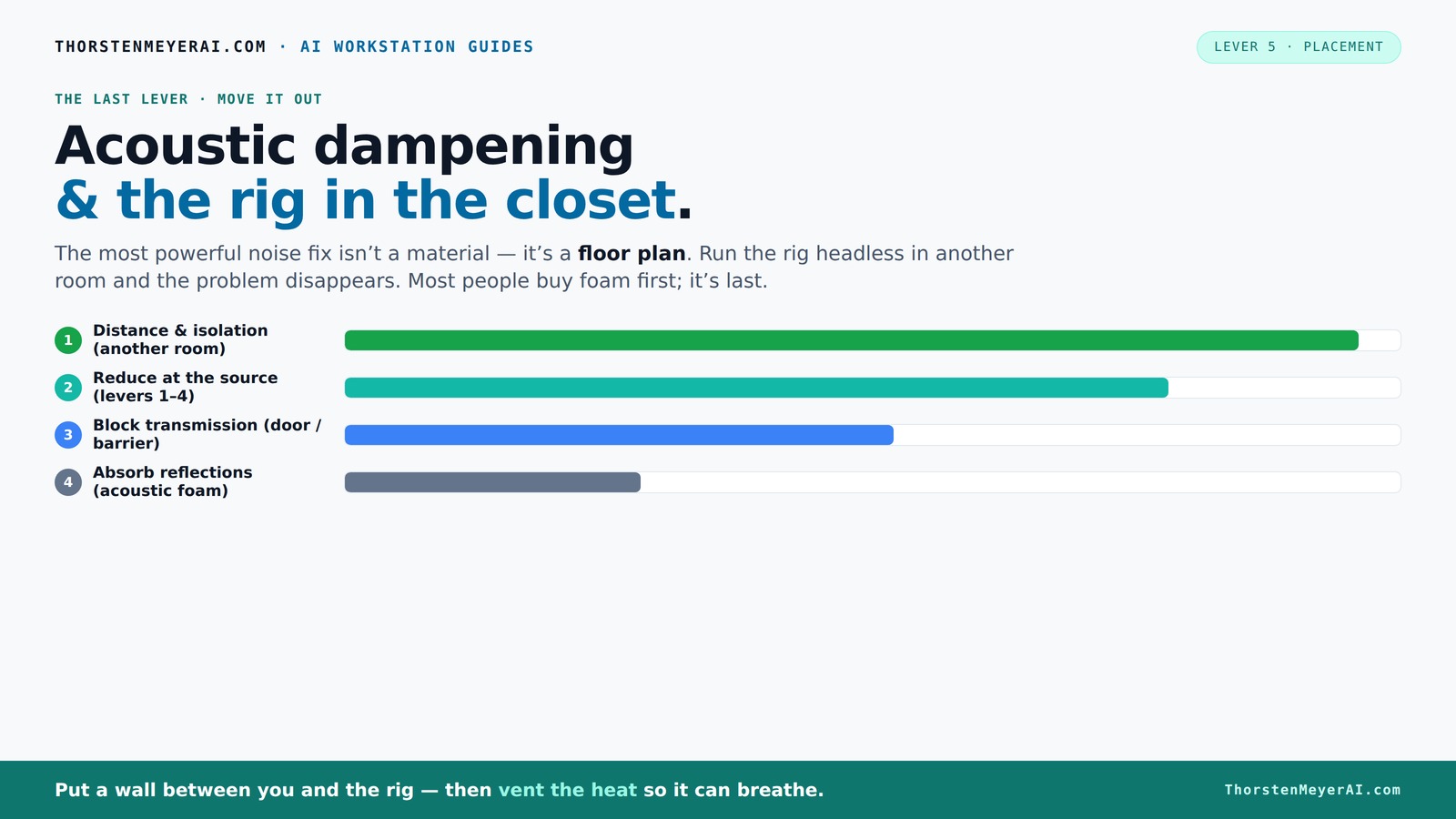
Acoustic dampening
& the rig in the closet.
The most powerful noise fix isn’t a material — it’s a floor plan. A rig you can’t hear because it’s in another room beats any amount of foam. Tap the approaches in Part 1 to see what actually works.
(another room)
(levers 1–4)
(door / barrier)
(acoustic foam)
Contain the noise, not the heat
Key Takeaways
- Distance and room separation are the most effective noise controls — move your rig away or into another room.
- A closet or cabinet can drastically reduce noise when properly ventilated, but heat management is critical. For detailed tips, see how to set up acoustic dampening in a closet.
- Layered soundproofing with mass, damping, and decoupling beats relying solely on foam or absorption.
- Placement of acoustic treatment at reflection points and sealing gaps improves clarity and reduces leaks.
- Address low-frequency noise with bass traps, mass-loaded vinyl, and active cooling — simple solutions work well.
soundproof acoustic panels for home studio
As an affiliate, we earn on qualifying purchases.
As an affiliate, we earn on qualifying purchases.
Why Distance Is Your Best Noise Solution
Distance and isolation beat every soundproofing product hands down. When you move your rig away from your workspace, the noise drops off dramatically. Think of it like a loud neighbor — you won’t hear much if they’re on the other side of the block.
For example, a GPU rig tucked into a spare room or basement, accessed over a network, can be roaring away while your desk remains whisper-quiet. This setup is especially handy for AI workloads, which often need powerful, heat-generating hardware.
All you need is a good network connection and some ventilation. The noise? It’s no longer your problem — it’s the room’s problem, not yours.
quiet computer case for noise reduction
As an affiliate, we earn on qualifying purchases.
As an affiliate, we earn on qualifying purchases.
How 'Rig in the Closet' Turns Noise Down — But Watch the Heat
Placing your rig inside a closet or cabinet can cut noise levels significantly — sometimes down to 30-36 dB. It’s like putting your noisy machine behind a thick wall. But there’s a catch: heat. A sealed closet traps warmth, turning your quiet solution into a hotbox.
Say you cram a 600W GPU into a closet with no airflow. The temperature climbs steadily, causing the fans to spin faster and louder — defeating your goal. To prevent this, you need active ventilation: intake and exhaust fans, or ducted airflow that pulls hot air out and brings in cool air.
Built-in soundproof cabinets with temperature controls and ducting are ideal. They combine damping, mass, and airflow management — a full package for quiet and cool.
Understanding this tradeoff is crucial. While a closet can effectively isolate noise, neglecting proper ventilation can lead to overheating, which not only reduces hardware lifespan but can also cause thermal throttling, decreasing performance. The key is balancing soundproofing with heat management to ensure your setup remains both quiet and safe.
As an affiliate, we earn on qualifying purchases.
The Real Secrets to Soundproofing: Mass, Damping, and Decoupling
Soundproofing isn’t just about slapping foam on the wall. It’s about layers of mass, damping, and decoupling. For more on effective soundproofing techniques, visit soundproofing tips and tricks. More mass means less sound gets through. Think of a thick brick wall versus a thin partition.
But vibrations travel through solid materials. Damping compounds like Green Glue convert vibration into heat, reducing transmission. Decoupling breaks the vibration path altogether with resilient channels or rubber grommets.
For example, installing Green Glue between drywall layers can cut low-frequency noise by up to 80%. Combining this with rubber feet under your rig isolates vibrations and keeps noise from traveling into your floor and walls.
These techniques matter because low-frequency sounds—like the hum from fans or motors—are particularly difficult to block. They tend to penetrate standard foam treatments and travel through structures, making layered approaches essential. The tradeoff is increased cost and complexity, but the payoff is a significantly quieter environment with less vibration transmission, which is especially important for sensitive audio or recording setups.
mass loaded vinyl soundproofing material
As an affiliate, we earn on qualifying purchases.
As an affiliate, we earn on qualifying purchases.
Placement Tips: Where to Put Acoustic Treatment in Your Room
Placement is everything. Acoustic panels work best at first reflection points — spots where sound bounces directly from your source to your ears. Learn more about optimal placement of acoustic treatment. For example, the wall directly behind your monitors or near your desk.
Hard surfaces like glass or bare walls reflect sound, creating echo and muddiness. Cover these with absorptive panels or foam. Soft materials like rugs, curtains, or fabric-covered panels keep the sound warm and clear.
Seal gaps around doors, windows, and outlets. Even tiny cracks let sound leak out or in, ruining your efforts. Use weatherstripping, acoustic caulk, or sealant. Remember, airtightness is key for effective soundproofing.
Understanding where to place acoustic treatment ensures the sound energy is absorbed or diffused at critical points, preventing unwanted reflections and controlling room acoustics. This strategic placement enhances clarity and prevents sound from bouncing around, which can muddy recordings or listening experiences. Neglecting these details can result in echo, muddiness, and reduced sound quality, so take the time to analyze your space carefully.
The Low-Frequency Challenge and How to Tackle It
Low-frequency sounds — that deep rumble from your GPU or server — are tough. They travel through walls and floors like a freight train. Discover solutions for tackling low-frequency noise. Absorbing these requires more than foam panels.
For example, bass traps placed in corners can soak up some low-end energy. Mass-loaded vinyl (MLV) added to walls helps block it. Using active cooling or exhaust systems also prevents heat buildup, which can intensify low-frequency noise.
Specialized solutions like tuned bass traps or active noise canceling systems are more advanced but worth the effort if low frequencies bother you.
The reason these low frequencies are so challenging is because they have longer wavelengths and higher energy, allowing them to penetrate common barriers and reflect within the room. Addressing this requires targeted solutions like bass traps, which absorb energy in critical areas, and adding mass to walls to increase their sound-blocking capability. The tradeoff involves cost, space, and installation complexity, but the result is a much quieter, more accurate environment for audio or sensitive work.
How to Build a Budget-Friendly, Effective Soundproof Setup
You don’t need a fortune to reduce noise. Start with simple steps: move your rig to a closet or spare room. Add some foam panels at reflection points. Seal gaps around doors and outlets. For more budget-friendly tips, see luxury home wellness products and relaxation devices.
Use rubber feet or anti-vibration pads under your hardware. Add a small exhaust fan if you’re enclosing a hot rig. For a few hundred dollars, you can make a big difference.
For example, a DIY closet setup with foam, weatherstripping, and a budget fan can cut noise by 50-60%. It’s not perfect, but it’s better than a noisy desk.
Understanding that affordable solutions can still be effective helps set realistic expectations. Prioritizing sealing gaps, using vibration isolation, and implementing proper ventilation creates a balance between cost and performance. The tradeoff is that while these methods won’t match professional-grade setups, they can significantly improve your environment without breaking the bank.
Common Mistakes and How to Avoid Them
Many DIYers think more foam is better — but it’s not enough. Gaps, leaks, and unventilated closets ruin the effort. Over-sealing can trap heat, causing performance issues.
Another mistake: ignoring vibrations. A noisy fan or hard surface transmits vibrations. Use rubber feet, decoupling mounts, and damping layers.
Finally, don’t forget airflow. A sealed closet traps heat. Make sure to add controlled ventilation to keep your rig cool and quiet.
Over-sealing or using insufficient damping can lead to ineffective noise reduction and potential hardware overheating. Ignoring vibrations allows noise to travel through structures, defeating the purpose of soundproofing. Proper ventilation, vibration isolation, and careful sealing are essential to avoid these pitfalls. Understanding these common mistakes ensures that your efforts translate into a quieter and more reliable setup, ultimately saving time and resources.
Frequently Asked Questions
What is the difference between dampening, damping, soundproofing, and acoustic treatment?
Soundproofing blocks sound from passing through walls, floors, or doors. Acoustic treatment improves how sound behaves inside a room — reducing echo and reflections. Damping specifically reduces vibrations within structures, preventing sound from traveling through walls or floors. Dampening and damping are often used interchangeably but focus on vibration control.
Do acoustic panels block sound, or only reduce echo?
Most acoustic panels primarily reduce echo and improve room clarity. They absorb reflections but don't block significant outside noise unless combined with other barriers. For true soundproofing, you need mass, airtight seals, and decoupling in addition to absorption.
Where should I place panels in a small room or closet setup?
Place panels at first reflection points — typically on the wall directly opposite your speakers and at your head height. Cover reflective surfaces like bare walls, ceilings, or windows with absorptive material. Seal gaps around doors and outlets for best results.
Is a closet a good recording booth?
Yes, if your goal is to isolate sound. But a closet can turn into a boxy, echo-y space without proper treatment. Add soft panels, bass traps, and ventilation to make it both quiet and acoustically balanced.
How much difference do mass-loaded vinyl or Green Glue make?
Adding mass-loaded vinyl can block significant low-frequency sound, reducing noise transmission by up to 80%. Green Glue between drywall layers dampens vibrations, improving soundproofing without extra weight. Both are effective but depend on proper installation.
Conclusion
Strategic placement and proper setup can turn a noisy rig into a whisper-quiet powerhouse. Moving your machine to a different room or closet often beats all the fancy foam in the world. Remember: heat and vibrations are your biggest enemies — manage them, and you’ll get a much better sound environment.
Now, whether you’re building a home studio or a quiet AI workstation, think of your space as an ecosystem. Tackle noise from all angles: distance, barriers, damping, and airflow. Your ears — and your neighbors — will thank you.
Fall yard work Picks
leaf blowers
As an affiliate, we earn on qualifying purchases.