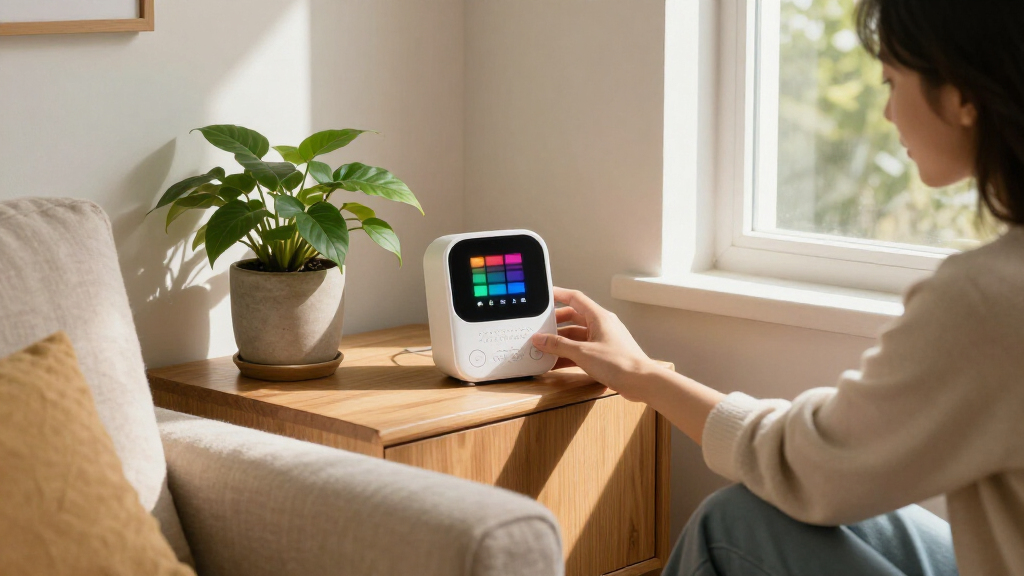

Smart air quality monitors can track indoor pollutants and conditions, but the right choice depends on which readings you need and how you plan to act on them. I rank the Airthings View Plus as the best overall for buyers seeking broad pollutant coverage, while the Amazon Smart Air Quality Monitor is a straightforward fit for Alexa homes and the GoveeLife H5106 offers an accessible display-led option. The main tradeoffs are sensor coverage, smart-home compatibility, and how much setup or ongoing app use a monitor requires. Some models focus on specific concerns such as radon or carbon monoxide, while others prioritize everyday readings like particulate matter, CO₂, temperature, and humidity. Read on for the full comparison and guidance on choosing a monitor that matches your rooms, routines, and priorities.

Get wellness gear delivered free with Prime
- Fast, free delivery on millions of items
- Prime Video, Amazon Music and more included
- Member-only deals all year
Key Takeaways
- The Airthings View Plus stands apart for broad coverage: it combines radon monitoring with other indoor air readings, making it a stronger fit for buyers who want more than a basic particulate or CO₂ monitor.
- Smart-home compatibility changes the experience: the Amazon and Ring options make the most sense for households already using their ecosystems, while a standalone monitor may suit buyers who want fewer connected-home dependencies.
- Screen-first models favor quick checks: several GoveeLife, SONOFF, and multi-sensor options put readings on the device, reducing reliance on opening an app just to check room conditions.
- Specialized sensors can matter more than a long sensor list: the Airthings Wave Plus focuses on radon-related monitoring, while the Kidde combines air monitoring with carbon monoxide detection; neither role is interchangeable with a general-purpose monitor.
- More listed measurements do not automatically mean better decisions: the 10-in-1 and 16-in-1 models advertise broad measurement counts, but buyers should check which pollutants are actually measured and which are calculated or ambient conditions.
| GoveeLife H5106 Smart Air Quality Monitor with LED Display |  | Best for GoveeLife Automation | Measurements: PM2.5, temperature, humidity | PM2.5 accuracy: ±15 µg/m³ from 0 to 100 µg/m³; ±15% from 100 to 1000 µg/m³ | Temperature accuracy: ±0.54°F | VIEW LATEST PRICE | See Our Full Breakdown |
| BREATHE Airmonitor Plus Gen 2 Indoor Air Quality Monitor |  | Best for Broad Pollutant Coverage | Measurements: CO₂, PM1, PM2.5, PM10, TVOC, formaldehyde, temperature, humidity | CO₂ sensor: NDIR | Particle sensor: Laser | VIEW LATEST PRICE | See Our Full Breakdown |
| Amazon Smart Air Quality Monitor |  | Best for Alexa Beginners | Sensors: PM2.5, VOCs, carbon monoxide, humidity, temperature | Connectivity: 2.4 GHz Wi-Fi and Bluetooth LE 4.2 | Compatibility: Echo devices and Alexa app version 2021.16 or later | VIEW LATEST PRICE | See Our Full Breakdown |
| SONOFF AirGuard SAWF-08P Smart Indoor Air Quality Monitor | 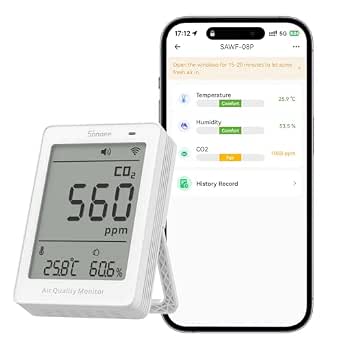 | Best for Matter Smart Homes | Model: SAWF-08P | Measurements: CO₂, temperature, humidity | CO₂ sensor and range: NDIR; 400–5000 ppm | VIEW LATEST PRICE | See Our Full Breakdown |
| 10-in-1 Indoor Air Quality Monitor with CO2 Detection |  | Best Portable Multi-Reading Display | Brand and model: Lwyinp MT13S | Measurements: CO₂, HCHO, TVOC, AQI, PM2.5, PM1.0, PM10, temperature, humidity, time | Display: High-definition color screen with three-color air-quality visualization | VIEW LATEST PRICE | See Our Full Breakdown |
| Ring Air Quality Monitor |  | Best for Ring and Sidewalk Households | Monitored metrics: Temperature, humidity, carbon monoxide, PM2.5 | Connectivity: Amazon Sidewalk | Dimensions: 1.83 x 2.56 x 2.56 inches | VIEW LATEST PRICE | See Our Full Breakdown |
| 16-in-1 Indoor Air Quality Monitor with HD Color Screen | 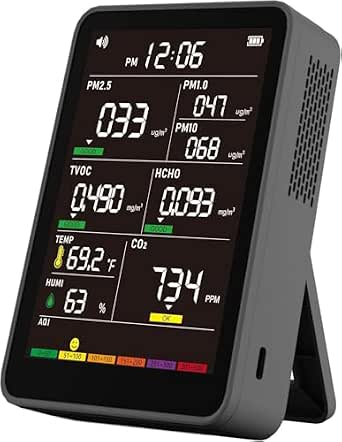 | Best Portable Multi-Metric Display | Measured parameters: PM1.0, PM2.5, PM10, TVOC, HCHO, temperature, and humidity | Sampling interval: 1.5 seconds | Display: HD color screen | VIEW LATEST PRICE | See Our Full Breakdown |
| Airthings Wave Plus Radon and Indoor Air Quality Monitor |  | Best for Radon Monitoring | Model: 2930 | Sensors: Radon, CO2, VOCs, humidity, temperature, and air pressure | Connectivity: Bluetooth | VIEW LATEST PRICE | See Our Full Breakdown |
| SONOFF SAWF-07P Smart Indoor Air Quality Monitor with PM2.5, PM10, Temperature & Humidity Sensor |  | Best for Matter Smart-Home Integration | Model: SAWF-07P | Monitored metrics: PM2.5, PM10, temperature, and humidity | Connectivity: 2.4GHz Wi-Fi, Matter-compatible | VIEW LATEST PRICE | See Our Full Breakdown |
| Amazon Smart Air Quality Monitor (2-Pack) | | Best for Alexa Coverage Across Two Rooms | Pack size: 2 monitors | Monitored factors: PM2.5, VOCs, carbon monoxide, humidity, and temperature | Connectivity: Alexa app and compatible Echo devices | VIEW LATEST PRICE | See Our Full Breakdown |
| Airthings View Plus Radon & Air Quality Monitor |  | Best for Broad, Radon-Focused Monitoring | Brand: Airthings | Model: 2960 | Connectivity: WiFi | VIEW LATEST PRICE | See Our Full Breakdown |
| Sacnahe Air Quality Monitor with Dual Chip Technology |  | Best for Portable, Multi-Parameter Readings | Model: SA-PV33-B | Monitored parameters: AQI, CO2, PM1.0, PM2.5, PM10, TVOC, HCHO, temperature, and humidity | Connectivity: 2.4GHz WiFi | VIEW LATEST PRICE | See Our Full Breakdown |
| INKBIRD IAM-T2 Smart Indoor Air Quality Monitor |  | Best for Long-Running CO2 Tracking Without WiFi | Model: IAM-T2 | Measurements: CO2, temperature, and humidity | Display: Backlit LCD | VIEW LATEST PRICE | See Our Full Breakdown |
| Kidde COPDLQW Smart Carbon Monoxide Detector with Indoor Air Quality Monitoring |  | Best for Combining CO Safety and Basic Air Monitoring | Model: COPDLQW | Power: 120V plug-in with two AA backup batteries | WiFi: 2.4GHz | VIEW LATEST PRICE | See Our Full Breakdown |
| GoveeLife H5140 Smart CO₂ Air Quality Monitor |  | Best for Always-On CO2 Monitoring | Model: H5140 | CO2 sensor: SCD4x photoacoustic NDIR | CO2 accuracy: ±(40 ppm + 5%) | VIEW LATEST PRICE | See Our Full Breakdown |
| smart air quality monitor | Connectivity | Power | Model |
|---|---|---|---|
| GoveeLife H5106 Smart Air Qual | Bluetooth and 2.4 GHz Wi-Fi | Wired Type-C; no built-in battery | — |
| BREATHE Airmonitor Plus Gen 2 | — | Rechargeable battery or USB-C | — |
| Amazon Smart Air Quality Monit | 2.4 GHz Wi-Fi and Bluetooth LE 4.2 | 5 W adapter; 100–240 V AC input, 5.0 V 1 A output | — |
| SONOFF AirGuard SAWF-08P Smart | 2.4 GHz Wi-Fi; Matter compatible | — | SAWF-08P |
| 10-in-1 Indoor Air Quality Mon | Bluetooth | — | — |
| Ring Air Quality Monitor | Amazon Sidewalk | 100–240 VAC, 50/60 Hz | — |
| 16-in-1 Indoor Air Quality Mon | — | — | — |
| Airthings Wave Plus Radon and | Bluetooth | 2 AA batteries | 2930 |
| SONOFF SAWF-07P Smart Indoor A | 2.4GHz Wi-Fi, Matter-compatible | — | SAWF-07P |
| Amazon Smart Air Quality Monit | Alexa app and compatible Echo devices | — | — |
| Airthings View Plus Radon & Ai | WiFi | Battery | 2960 |
| Sacnahe Air Quality Monitor wi | 2.4GHz WiFi | — | SA-PV33-B |
| INKBIRD IAM-T2 Smart Indoor Ai | Bluetooth 5.0 | — | IAM-T2 |
| Kidde COPDLQW Smart Carbon Mon | — | 120V plug-in with two AA backup batteries | COPDLQW |
| GoveeLife H5140 Smart CO₂ Air | App, Alexa, and Google Assistant | AC outlet | H5140 |
More Details on Our Top Picks
GoveeLife H5106 Smart Air Quality Monitor with LED Display
The GoveeLife H5106 is a focused choice for tracking everyday room conditions and using changes to trigger compatible GoveeLife appliances. It measures PM2.5, temperature, and humidity, with readings refreshed every two seconds; remote access, graphs, and data export add useful context beyond its on-device display. Compared with the broader-reading BREATHE Airmonitor Plus Gen 2, it covers fewer pollutants, but its appliance-linking feature makes it more appealing to someone building around GoveeLife. Its main limitation is the narrow sensor set: it does not report CO₂, VOCs, or formaldehyde. The wired design also means it needs a nearby power source, so it is less flexible to move than a battery-capable monitor. I’d choose it for connected PM2.5 tracking, not as an all-in-one pollution detector.
Pros:- Tracks PM2.5, temperature, and humidity in one unit
- Refreshes readings every two seconds
- Offers remote monitoring, graphs, and data export
- Can trigger compatible GoveeLife appliances when conditions change
Cons:- Does not measure CO₂, VOCs, or formaldehyde
- Requires wired power and has no built-in battery
- Time display requires a 2.4 GHz Wi-Fi connection
Best for: GoveeLife owners who want PM2.5, temperature, and humidity readings to support remote monitoring and compatible appliance automation.
Not ideal for: Buyers seeking CO₂, VOC, or formaldehyde readings, or anyone who needs a monitor that can operate away from a power outlet.
- Measurements:PM2.5, temperature, humidity
- PM2.5 accuracy:±15 µg/m³ from 0 to 100 µg/m³; ±15% from 100 to 1000 µg/m³
- Temperature accuracy:±0.54°F
- Humidity accuracy:±3% RH
- Response time:2 seconds
- Connectivity:Bluetooth and 2.4 GHz Wi-Fi
- Data:13-day online graphs; export for up to 2 years
- Power:Wired Type-C; no built-in battery
Our verdict“Choose the H5106 if you want fast PM2.5 updates and GoveeLife appliance automation, but skip it if you need broader pollutant coverage or portability.”
BREATHE Airmonitor Plus Gen 2 Indoor Air Quality Monitor
For readers who want one monitor to cover several kinds of indoor pollution, the BREATHE Airmonitor Plus Gen 2 stands out with readings for CO₂, three particle sizes, TVOC, and formaldehyde, alongside temperature and humidity. Its display makes current conditions visible at the device, while app alerts, 90-day history, and data export help track changes over time. Compared with the GoveeLife H5106, it measures a much wider set of pollutants, though it gives up the Govee model’s stated appliance-triggering role. The NDIR CO₂ and laser particle sensors add useful detail, but the rechargeable battery lasts up to six hours, making it better for short moves between rooms than all-day untethered use. It also depends on 2.4 GHz Wi-Fi for app connectivity.
Pros:- Measures eight categories, including CO₂, PM1, PM2.5, PM10, TVOC, and formaldehyde
- Shows readings on the device as well as in the app
- Provides configurable alerts, 90-day history, and data export
- Can run on battery or USB-C power
Cons:- Portable battery use lasts up to 6 hours
- App connectivity requires 2.4 GHz Wi-Fi
- Does not offer the GoveeLife H5106’s stated appliance-triggering integration
Best for: Households or small offices that want a single displayed monitor for CO₂, particles, gases, temperature, and humidity, plus app history.
Not ideal for: People who need long battery-powered operation or want readings and alerts without connecting the monitor to 2.4 GHz Wi-Fi.
- Measurements:CO₂, PM1, PM2.5, PM10, TVOC, formaldehyde, temperature, humidity
- CO₂ sensor:NDIR
- Particle sensor:Laser
- Battery life:Up to 6 hours
- App connectivity:2.4 GHz Wi-Fi
- Data history:Up to 90 days
- Power:Rechargeable battery or USB-C
- Display:On-device display
Our verdict“Pick the BREATHE if broad pollutant coverage and app history matter more than long untethered use or direct appliance automation.”
Amazon Smart Air Quality Monitor
The Amazon Smart Air Quality Monitor suits buyers who want a simple entry point into air-quality alerts and Alexa routines rather than a screen full of pollutant measurements. It tracks PM2.5, VOCs, carbon monoxide, temperature, and humidity, with a color-coded LED for a quick status check and more detail in the Alexa app. When conditions change, it can send alerts or trigger compatible Alexa devices, giving it a more automation-centered role than the BREATHE Airmonitor Plus Gen 2, which offers wider pollutant coverage and on-device readings. The tradeoff is that connected features depend on the Alexa app and compatible Alexa devices; buyers outside that ecosystem get less value from its smart functions. It is also an indoor-only monitor, not a portable sensor for varied settings.
Pros:- Measures PM2.5, VOCs, carbon monoxide, temperature, and humidity
- Uses a color-coded LED for a quick status check
- Can send alerts and trigger compatible Alexa routines
- Adds temperature and humidity sensing for climate-control routines
Cons:- Connected features rely on the Alexa app and compatible Alexa devices
- Does not measure CO₂ or formaldehyde
- Designed for indoor use only
Best for: Alexa households that want straightforward air-quality alerts and routines alongside temperature and humidity readings.
Not ideal for: Buyers who do not use Alexa, want an on-device numeric display, or need broader measurements such as CO₂ and formaldehyde.
- Sensors:PM2.5, VOCs, carbon monoxide, humidity, temperature
- Connectivity:2.4 GHz Wi-Fi and Bluetooth LE 4.2
- Compatibility:Echo devices and Alexa app version 2021.16 or later
- Dimensions:65 × 65 × 45 mm (W × L × H)
- Weight:120 g without cable or adapter
- Power:5 W adapter; 100–240 V AC input, 5.0 V 1 A output
- Operating conditions:Indoor use; 0–40 °C and 0–80% humidity
- Included:Monitor, Micro-USB cable, power adapter, Quick Start Guide
Our verdict“Choose this monitor for Alexa-based alerts and routines, but select the BREATHE Airmonitor Plus Gen 2 if you want broader readings and an on-device display.”
SONOFF AirGuard SAWF-08P Smart Indoor Air Quality Monitor
The SONOFF AirGuard SAWF-08P is the clearest fit here for buyers whose priority is CO₂ monitoring across a mixed smart-home setup. Its NDIR sensor measures CO₂ alongside temperature and humidity, while Matter compatibility supports integration with platforms including Apple Home, Alexa, Google Home, SmartThings, and Home Assistant. That wider platform reach is a meaningful contrast with the Alexa-dependent Amazon Smart Air Quality Monitor. A display, sound, LED, and app notifications give several ways to notice changing conditions, and 12 months of history with export supports longer-term tracking. The tradeoff is a narrower sensor range: it does not report particulate matter, VOCs, or formaldehyde. It also needs continuous power and 2.4 GHz Wi-Fi, so it is not a portable choice.
Pros:- Uses an NDIR sensor for CO₂ monitoring
- Matter compatibility supports several major smart-home platforms
- Stores up to 12 months of historical data with export
- Offers sound, LED, and app notifications
Cons:- Tracks CO₂, temperature, and humidity but not particles or VOCs
- Requires continuous power for real-time updates
- Requires a 2.4 GHz Wi-Fi network
Best for: Smart-home users who mainly want CO₂, temperature, and humidity monitoring integrated across Matter-compatible platforms.
Not ideal for: Buyers who need particle or VOC measurements, battery operation, or a monitor that connects to 5 GHz Wi-Fi.
- Model:SAWF-08P
- Measurements:CO₂, temperature, humidity
- CO₂ sensor and range:NDIR; 400–5000 ppm
- CO₂ accuracy:±(50 ppm + 5%)
- Connectivity:2.4 GHz Wi-Fi; Matter compatible
- Compatibility:Apple Home, Amazon Alexa, Google Home, SmartThings, Home Assistant
- Update frequency:Every 5 seconds
- Historical data:12 months with export via the eWeLink app
- Dimensions and weight:2.76 × 4.1 × 1.02 inches; 3.56 ounces
Our verdict“Choose the SAWF-08P for Matter-based CO₂ tracking across smart-home platforms, but pick the BREATHE Airmonitor Plus Gen 2 for broader pollutant coverage.”
10-in-1 Indoor Air Quality Monitor with CO2 Detection
The 10-in-1 Indoor Air Quality Monitor is aimed at buyers who want many readings visible on one portable screen, including CO₂, formaldehyde, TVOC, particle measures, temperature, and humidity. Its three-color display is intended to make changing air conditions easier to scan, and the listed use settings include homes, offices, and vehicles. Compared with the GoveeLife H5106, it covers more measurement categories and is described as portable, but it lacks the Govee monitor’s specified Wi-Fi graphs, data export, and appliance automation. Its smart features are also more limited: Bluetooth is used for clock calibration, not described as a remote-monitoring or alert connection. The product data does not state battery life or measurement ranges, so I’d favor it for at-a-glance readings rather than buyers who need documented measurement limits or app-based tracking.
Pros:- Lists readings for gases, particulates, temperature, humidity, and AQI
- Color screen presents readings and air-quality changes at a glance
- Designed for use across several indoor settings
- Bluetooth supports clock calibration
Cons:- Battery life and measurement ranges are not specified
- Bluetooth is described for clock calibration, not remote monitoring or alerts
- Does not list the Wi-Fi history and data-export features available on the GoveeLife H5106
Best for: People who want a portable, on-device snapshot of multiple air-quality readings across indoor spaces such as rooms, offices, or vehicles.
Not ideal for: Buyers who need documented measurement ranges, specified battery runtime, Wi-Fi monitoring, or reliable app-based history and alerts.
- Brand and model:Lwyinp MT13S
- Measurements:CO₂, HCHO, TVOC, AQI, PM2.5, PM1.0, PM10, temperature, humidity, time
- Display:High-definition color screen with three-color air-quality visualization
- Connectivity:Bluetooth
- Color:Black
- Included items:Monitor, charging cable, user manual
Our verdict“Pick this model for portable, on-screen multi-reading checks, but choose a monitor with stated measurement ranges and app history if you need more trackable data.”
Ring Air Quality Monitor
Ring Air Quality Monitor pairs readings for PM2.5, carbon monoxide, temperature, and humidity with alerts and suggestions for improving indoor air. Its Amazon Sidewalk connection means it does not need a separate base station, making setup simpler than a monitor that depends on its own hub. Compared with the Amazon Smart Air Quality Monitor (2-Pack), it is a single compact unit rather than a way to cover two rooms, and its Sidewalk connectivity is the defining fit for households already within Sidewalk coverage. The tradeoff is important: its CO reading does not replace a certified carbon monoxide alarm, and there is no local speaker for audible alerts. It also omits CO2 and radon, so buyers seeking those measurements should look at the Airthings Wave Plus instead.
Pros:- Tracks PM2.5, CO, temperature, and humidity in one compact device.
- Uses Amazon Sidewalk without requiring a separate base station.
- Provides alerts and suggestions aimed at improving indoor air.
- Small footprint suits indoor placement where space is limited.
Cons:- CO monitoring is not a substitute for a certified carbon monoxide alarm.
- No built-in speaker for local audible alerts.
- Does not measure CO2 or radon, and operation depends on Sidewalk coverage.
Best for: Ring or Amazon households with Sidewalk coverage that want compact indoor readings and app-based air-quality suggestions.
Not ideal for: Buyers who need a certified CO alarm, local audible warnings, CO2 or radon readings, or dependable operation where Sidewalk coverage is unavailable.
- Monitored metrics:Temperature, humidity, carbon monoxide, PM2.5
- Connectivity:Amazon Sidewalk
- Dimensions:1.83 x 2.56 x 2.56 inches
- Power:100–240 VAC, 50/60 Hz
- Operating temperature:32°F to 120°F (0°C to 49°C)
- Certifications:UL, FCC
- Warranty:One-year limited warranty
Our verdict“Choose the Ring if your home has Sidewalk coverage and you want compact readings and suggestions, but keep a certified CO alarm for life-safety protection.”
16-in-1 Indoor Air Quality Monitor with HD Color Screen
This monitor suits buyers who want many readings on a dedicated screen rather than a smart-home app as the main interface. It measures PM1.0, PM2.5, PM10, TVOC, HCHO, temperature, and humidity, with readings refreshed every 1.5 seconds. That breadth gives it a different role from the Ring Air Quality Monitor, which adds CO but covers fewer particle and chemical indicators. The color display and adjustable audio prompts make readings accessible without opening a phone, while the rechargeable battery lets you move it between rooms. Portability comes with a clear limit: its stated 4–5 hours of battery life is better suited to short checks or temporary placement than all-day monitoring away from an outlet. It also does not list CO or CO2 measurement, unlike some connected alternatives in this roundup.
Pros:- Measures seven listed indicators, including PM1.0, PM2.5, PM10, TVOC, and HCHO.
- Updates readings every 1.5 seconds.
- HD color screen and adjustable audio prompts provide on-device feedback.
- Includes USB-C charging cable, AC adapter, and a 12-month warranty.
Cons:- Battery lasts only 4–5 hours per charge.
- Does not list CO or CO2 among its measured parameters.
- The listed feature set centers on local readings rather than smart-home integration.
Best for: People who want a portable, screen-based monitor to check particle and chemical readings in different rooms without relying on an app.
Not ideal for: Buyers who need continuous battery-powered monitoring, carbon monoxide or CO2 readings, or smart-home alerts and automations.
- Measured parameters:PM1.0, PM2.5, PM10, TVOC, HCHO, temperature, and humidity
- Sampling interval:1.5 seconds
- Display:HD color screen
- Battery life:4–5 hours
- Charging:USB Type-C
- Dimensions:1.6 x 5.3 x 6.7 inches
- Weight:14.4 ounces
- Warranty:12 months
Our verdict“Pick this model for portable, fast-updating readings on a screen, but skip it if you need long battery runtime or connected automations.”
Airthings Wave Plus Radon and Indoor Air Quality Monitor
The Airthings Wave Plus earns its place for buyers who want radon included alongside everyday indoor-air readings. It monitors radon, CO2, VOCs, humidity, temperature, and air pressure, a broader mix of gases than the SONOFF SAWF-07P, which focuses on particles and comfort conditions. Battery power and up to 16 months of battery life make placement flexible without keeping a power cable nearby. A color-coded indicator offers a quick on-device check, while the app supplies more detailed insights over Bluetooth. The compromise is less immediate connectivity: the sensors need a seven-day settling period, and app access relies on Bluetooth rather than the Wi-Fi and Matter approach of the SONOFF. Choose this for radon awareness and long battery life, not instant setup or app access from anywhere.
Pros:- Measures radon and CO2 alongside VOCs and environmental conditions.
- Color-coded device indicator provides a quick reading at a glance.
- Bluetooth app offers detailed insights and analytics.
- Runs on two AA batteries for up to 16 months.
Cons:- Sensors require a seven-day settling period.
- App connectivity uses Bluetooth rather than Wi-Fi.
- Does not list PM2.5 or PM10 among its monitored factors.
Best for: Homeowners who want ongoing radon and CO2 monitoring with flexible, battery-powered placement.
Not ideal for: Buyers who need readings immediately after setup, remote Wi-Fi app access, or particle measurements such as PM2.5 and PM10.
- Model:2930
- Sensors:Radon, CO2, VOCs, humidity, temperature, and air pressure
- Connectivity:Bluetooth
- Power:2 AA batteries
- Battery life:Up to 16 months
- Sensor settling period:7 days
- Included:2 AA batteries and quick start guide
- Warranty:Optional 5-year extended warranty; registration required within 30 days
Our verdict“Choose the Wave Plus when radon monitoring and long battery life matter more than particle readings or remote Wi-Fi access.”
SONOFF SAWF-07P Smart Indoor Air Quality Monitor with PM2.5, PM10, Temperature & Humidity Sensor
The SONOFF SAWF-07P is the strongest fit here for buyers who want air readings woven into a broader smart home. Its Matter compatibility supports integration with Apple Home, Alexa, Google Home, and other listed platforms, while sound, LED, and app notifications give it more alert routes than the Bluetooth-only Airthings Wave Plus. The 3.73-inch screen keeps readings visible, and the device tracks PM2.5, PM10, temperature, and humidity with a stated two-second response time. Twelve months of historical data and export help buyers follow changes instead of relying on a single glance. Its scope is narrower than the 16-in-1 monitor: it does not list VOC, HCHO, CO, CO2, or radon. It also needs continuous power and 2.4GHz Wi-Fi, so it is less flexible to place than a battery-powered monitor.
Pros:- Matter compatibility supports integration across major smart-home platforms.
- Tracks PM2.5, PM10, temperature, and humidity on a 3.73-inch screen.
- Offers sound, LED, and app notifications with a two-second response time.
- Stores and exports up to 12 months of historical data.
Cons:- Requires continuous power rather than battery operation.
- Wi-Fi support is limited to 2.4GHz networks.
- Does not list CO2, radon, VOC, or HCHO monitoring.
Best for: Smart-home users who want Matter-connected particle, temperature, and humidity readings with alerts and year-long data history.
Not ideal for: People seeking battery-powered placement, 5GHz-only Wi-Fi support, or measurements for CO2, radon, VOCs, or HCHO.
- Model:SAWF-07P
- Monitored metrics:PM2.5, PM10, temperature, and humidity
- Connectivity:2.4GHz Wi-Fi, Matter-compatible
- Screen size:3.73 inches
- PM2.5 accuracy:±10 μg/m³ (0–100 μg/m³); ±10% (100–500 μg/m³)
- Temperature and humidity accuracy:±1°F; ±3% RH
- Response time:2 seconds
- Power source:Continuous power supply
- Dimensions and weight:2.36 x 4.72 x 5.51 inches; 0.22 kg
Our verdict“Choose the SONOFF if Matter integration, alerts, and historical data matter more than battery placement or a wider range of gas measurements.”
Amazon Smart Air Quality Monitor (2-Pack)
This two-pack makes the most sense for Alexa households that want to monitor two indoor locations and trigger compatible devices when air quality changes. Each monitor tracks PM2.5, VOCs, CO, humidity, and temperature; the Alexa app provides details and alerts, while Alexa Routines can control compatible purifiers, fans, and dehumidifiers. That automation focus separates it from the Airthings Wave Plus, which adds radon and CO2 but relies on Bluetooth for app connectivity. The bundle’s value is in spreading monitoring across rooms, not in broadening the sensor list. Setup and detailed information require the Alexa app, and routines work only with compatible Alexa devices. As with the Ring monitor, the CO reading should not be treated as a replacement for a certified carbon monoxide alarm.
Pros:- Two monitors support air-quality coverage in separate rooms.
- Tracks PM2.5, VOCs, CO, humidity, and temperature.
- Alexa app alerts and details can connect with compatible Echo devices.
- Alexa Routines can trigger compatible air-treatment devices.
Cons:- Setup and detailed readings require the Alexa app.
- Automation is limited to compatible Alexa devices.
- Does not list CO2 or radon monitoring, and its CO reading is not a certified alarm.
Best for: Alexa households that want to monitor two rooms and automate compatible air purifiers, fans, or dehumidifiers.
Not ideal for: Buyers outside the Alexa ecosystem, anyone seeking radon or CO2 readings, or households that need a certified CO alarm.
- Pack size:2 monitors
- Monitored factors:PM2.5, VOCs, carbon monoxide, humidity, and temperature
- Connectivity:Alexa app and compatible Echo devices
- Alerts:Phone notifications or Echo announcements
- Automation:Alexa Routines for compatible devices
- Setup:Plug in and follow instructions in the Alexa app
Our verdict“Choose the two-pack to monitor two rooms and automate compatible devices through Alexa, but look elsewhere for radon, CO2, or certified CO protection.”
Airthings View Plus Radon & Air Quality Monitor
The Airthings View Plus is the strongest fit here for buyers who want radon readings alongside a broad set of indoor air measurements. It tracks seven metrics, including PM2.5, CO2, and VOCs, while the customizable eInk display makes readings available without opening an app. Compared with the CO2-focused GoveeLife H5140, it gives a more rounded view of potential air concerns, particularly for homes where radon monitoring matters. The tradeoff is that WiFi and an account are required, so it is less appealing to buyers who prefer offline or app-free monitoring. Battery power allows flexible placement, but it also means planning for eventual battery replacement. I’d choose it for wide coverage, not for a simple CO2 check.
Pros:- Tracks radon, PM2.5, CO2, VOCs, humidity, temperature, and air pressure
- Battery power permits placement away from an outlet
- Customizable eInk screen shows readings locally
- App includes trend analysis and pollen forecasts
Cons:- Requires an account and internet connection to function
- Battery operation brings periodic replacement needs
- Broader monitoring may be more than buyers seeking only CO2 data need
Best for: Homeowners who want radon tracked alongside particles, gases, and basic comfort conditions in one app-connected monitor
Not ideal for: Buyers who want an account-free device, or who only need CO2 readings and would prefer a simpler monitor such as the GoveeLife H5140
- Brand:Airthings
- Model:2960
- Connectivity:WiFi
- Power:Battery
- Sensors:Radon, PM2.5, CO2, VOC, humidity, temperature, and pressure
- Operating temperature:4 to 40°C (39 to 104°F)
- Warranty:5 years with registration
Our verdict“Choose the View Plus if radon and broad air-quality coverage matter more than account-free operation or a narrowly focused CO2 monitor.”
Sacnahe Air Quality Monitor with Dual Chip Technology
The Sacnahe SA-PV33-B covers an unusually wide mix of readings for a portable, app-connected monitor: CO2, particulate sizes, TVOC, HCHO, temperature, and humidity, among others. Its 3000mAh battery gives it a short-term use away from an outlet, while wall mounting suits a more permanent home or office position. Compared with the Airthings View Plus, Sacnahe lists more particle-size categories and formaldehyde, but it does not list radon; the Airthings is the better match when that specific measurement is a priority. Sacnahe’s color-coded LCD keeps readings visible at a glance, though its WiFi setup has a 2.4GHz requirement and pairing is limited to one phone at a time. I’d pick it for broad readings and placement flexibility, not shared app access.
Pros:- Lists CO2, PM1.0, PM2.5, PM10, TVOC, HCHO, temperature, and humidity monitoring
- Color-coded HD LCD presents readings on the device
- 3000mAh battery supports portable use for 7–15 hours
- Works with Smart Life and Tuya Smart apps for remote monitoring and history
Cons:- WiFi connection is limited to 2.4GHz and may require router compatibility adjustments
- Only one phone can connect to the WiFi pairing at a time
- Does not list radon monitoring, unlike the Airthings View Plus
Best for: Home or office users who want many listed air measurements, a local color display, and the option to move the monitor between locations
Not ideal for: Households that need radon monitoring or want multiple phones connected to the same WiFi pairing
- Model:SA-PV33-B
- Monitored parameters:AQI, CO2, PM1.0, PM2.5, PM10, TVOC, HCHO, temperature, and humidity
- Connectivity:2.4GHz WiFi
- App compatibility:Smart Life and Tuya Smart
- Battery:3000mAh
- Charging port:USB Type-C
- Display:HD LCD with color-coded status bars
- Mounting:Wall-mounted or portable
Our verdict“Pick Sacnahe for portable, broad-category readings and a local display, but skip it if radon or shared phone access is a priority.”
INKBIRD IAM-T2 Smart Indoor Air Quality Monitor
The INKBIRD IAM-T2 keeps its scope focused on CO2, temperature, and humidity, then adds a useful advantage: 30 days of offline data storage. Bluetooth app access and local sound and color alerts make it a practical choice for someone who wants a record of room conditions without relying on WiFi. That focus is narrower than the Sacnahe SA-PV33-B, which lists particles and VOC-related measurements, but the INKBIRD’s advertised battery life of more than six months per charge can make it easier to leave in place for ongoing CO2 tracking. Its Bluetooth connection depends on signal conditions, and a recharge takes about six hours. I’d favor it for a portable, low-maintenance CO2 history; buyers who need radon, particulate, or VOC readings should look to a broader monitor.
Pros:- Tracks CO2, temperature, and humidity
- Stores up to 30 days of readings offline
- Provides audible and color-coded alerts
- Advertised battery life exceeds six months per charge
Cons:- Does not monitor PM2.5, VOCs, or radon like broader options such as Sacnahe or Airthings View Plus
- Bluetooth range depends on an unobstructed signal
- Charging takes about six hours
Best for: People monitoring CO2 in bedrooms, offices, or other rooms who want offline history and alerts without WiFi
Not ideal for: Buyers who need particle, VOC, or radon measurements, or who want remote access beyond Bluetooth range
- Model:IAM-T2
- Measurements:CO2, temperature, and humidity
- Display:Backlit LCD
- Connectivity:Bluetooth 5.0
- Bluetooth range:Up to 100 meters unobstructed
- Battery:3000mAh lithium battery
- Advertised battery life:More than six months per charge
- Offline data storage:Up to 30 days
- Charging time:About six hours
Our verdict“Choose the IAM-T2 for portable CO2 tracking with offline history, but not for a broad survey of air pollutants.”
Kidde COPDLQW Smart Carbon Monoxide Detector with Indoor Air Quality Monitoring
The Kidde COPDLQW is first a carbon monoxide safety device, with TVOC, temperature, and humidity monitoring added for a broader look at indoor conditions. Its low-level CO alerts and 85 dB alarm make it distinct from dedicated air monitors such as the GoveeLife H5140, which tracks CO2 but is not a CO alarm. Plug-in power keeps Kidde in place, while AA backup batteries help maintain operation through a power outage; Alexa and Google Home compatibility add smart-home options. The tradeoff is narrower air-quality coverage: it does not list CO2 or particulate monitoring. Advanced air-quality insights also require a paid subscription, although the product description says app alerts do not require one. I’d choose it to combine CO protection and basic air data, not as a full air-monitoring station.
Pros:- Combines carbon monoxide detection with TVOC, temperature, and humidity monitoring
- Includes AA battery backup for power outages
- Sends real-time app alerts without a subscription
- Supports Alexa and Google Home and lists low-level CO alerts
Cons:- Does not list CO2 or PM2.5 monitoring, unlike the GoveeLife H5140 and broader air monitors
- Advanced air-quality insights require a paid subscription
- Requires 2.4GHz WiFi
Best for: Households that want a plug-in CO detector with app alerts, backup batteries, and a few additional indoor air readings
Not ideal for: Buyers seeking detailed air analysis, especially CO2 or particulate readings, or those who want advanced insights without a subscription
- Model:COPDLQW
- Power:120V plug-in with two AA backup batteries
- WiFi:2.4GHz
- Monitoring:Carbon monoxide, temperature, humidity, and TVOC
- Alarm volume:85 dB
- Low-level CO alerts:30–70 ppm
- Smart home compatibility:Amazon Alexa and Google Home
- Certification:UL 2034, 5th Edition; ETL Listed
- Warranty:10-year limited warranty
Our verdict“Choose Kidde when CO safety is the main need and basic air readings are a useful extra, rather than a replacement for a dedicated air monitor.”
GoveeLife H5140 Smart CO₂ Air Quality Monitor
The GoveeLife H5140 is a focused pick for rooms where CO2, temperature, and humidity are the readings that matter most. Its photoacoustic NDIR CO2 sensor refreshes every five seconds, while adjustable alarms and a dimmable display make it suited to continuous use in a bedroom, office, or shared space. Compared with the INKBIRD IAM-T2, GoveeLife needs continuous outlet power rather than relying on a rechargeable battery, but it offers Alexa and Google Assistant connectivity plus up to two years of data history and export. Neither model lists radon, particulate, or VOC measurement, so buyers wanting broad pollutant coverage should look at the Airthings View Plus instead. The clock also requires an app connection, and outdoor calibration may be needed. I’d choose this for plugged-in CO2 tracking and long-term records.
Pros:- Uses an SCD4x photoacoustic NDIR sensor for CO2 measurement
- Refreshes readings every five seconds
- Tracks and exports up to two years of data
- Supports Alexa and Google Assistant with customizable alarms
Cons:- Requires continuous AC power, unlike the rechargeable INKBIRD IAM-T2
- Measures CO2, temperature, and humidity rather than a broad range of pollutants
- Clock requires an app connection, and outdoor calibration may be needed
Best for: People who want continuous, app-connected CO2 monitoring with voice assistant support and a long record of readings
Not ideal for: Buyers who need battery-powered portability or monitoring of radon, particulates, or VOCs
- Model:H5140
- CO2 sensor:SCD4x photoacoustic NDIR
- CO2 accuracy:±(40 ppm + 5%)
- Refresh rate:5 seconds
- Measurements:CO2, temperature, and humidity
- Power:AC outlet
- Connectivity:App, Alexa, and Google Assistant
- Data history:Up to two years
Our verdict“Pick the H5140 for plugged-in CO2 monitoring, voice control, and extended history; choose a broader sensor set if you need more than room ventilation data.”

How We Picked
I ranked these smart air quality monitors by how usefully their sensors address common indoor-air questions, including particulate pollution, CO₂, radon, carbon monoxide, temperature, and humidity. I also weighed whether readings are easy to see on the device or in an app, how clearly alerts and smart-home connections fit a household routine, and whether the product’s stated purpose is specific enough to guide a buying decision. A longer sensor list did not automatically earn a higher position; I gave more weight to relevant coverage and practical access to readings.
The ordering favors models with a strong balance of useful coverage, day-to-day usability, and a clearly defined role. Specialized safety or pollutant monitors rank well for the buyers who need that function, but below more versatile options for a general roundup. I also considered limitations such as ecosystem dependence, a narrower measurement focus, or the need to interpret readings yourself. Since product capabilities and app support can change, buyers should confirm current sensor specifications and compatibility before choosing.
Factors to Consider When Choosing Smart Air Quality Monitors
Before choosing a model, decide what question you want the monitor to answer. A device that tracks CO₂ may help you spot poor ventilation, but it does not replace a radon monitor or a certified carbon monoxide alarm. I recommend starting with the pollutant or room condition that matters most, then checking how the device communicates a change and what action you can take.
Choose Sensors Around a Real Concern
Start with a specific concern rather than counting the measurements printed on the box. Particulate matter, CO₂, radon, and carbon monoxide are different readings, and each points to a different kind of response. Temperature and humidity add useful context, but they do not reveal every pollutant. A multi-sensor device can be convenient, yet its sensor list may omit the measurement you care about most. Check whether a reading is directly measured, estimated, or absent before comparing models. For health or safety concerns, use the monitor as one source of information, not a diagnosis or substitute for required alarms and professional advice.
Match the Monitor to the Room
Air readings describe the area around the sensor, not every room in a home. One monitor may miss room-to-room differences caused by cooking, a basement, pets, or uneven ventilation. A portable unit can be moved between rooms, but readings taken in different places and at different times are harder to compare. Multi-unit options make more sense when you want to watch separate spaces at once. Place a monitor where air can circulate, away from direct sunlight, open windows, vents, and sources that could distort a reading. Before buying, consider whether you need continuous coverage in one location or a way to sample several rooms.
Decide How You Want to See and Use Readings
A built-in display is useful for quick checks and for households where not everyone wants to use an app. App alerts are better suited to remote updates, but they depend on connectivity, account setup, and compatible devices. Think about who will notice an alert and what they can do in response; a notification that goes unread adds little value. Some buyers will prefer a smart-home routine that can trigger another device, while others may value a simple standalone screen. Review app permissions and account requirements if you want to limit connected services. The easiest system to maintain is often the one everyone in the household can read.
Check Smart-Home Compatibility Before Buying
“Smart” does not mean every monitor works with every assistant, hub, or automation platform. Compatibility can determine whether a reading stays in one app or joins your existing home setup. Confirm the specific connection supported by the model, rather than assuming that Wi-Fi or an app guarantees voice control or automations. If you already use Alexa or Ring devices, an option in that ecosystem may reduce setup friction. Buyers with mixed-brand homes may prefer to prioritize a clear on-device display and reliable app access over integrations. Also check whether features require a subscription, account, or particular network band.
Balance Sensor Breadth Against Clarity
A monitor reporting many readings can seem like an easy all-in-one choice, but the number alone says little about sensor usefulness. Prioritize measurement quality and understandable thresholds over a high count of displayed metrics. Look for clear units, trend history, and guidance that explains what a change may mean. If a device reports multiple conditions without telling you how they relate, it can create more uncertainty than insight. A focused monitor may be the better purchase when you have one clear concern, while broad coverage suits buyers who want a general household snapshot. Check the product documentation for the exact sensors and any stated limitations.
Know When to Pay for a Specialized Device
Broader coverage is not always the best use of a household’s monitoring budget. Specialized monitoring earns its place when it addresses a specific risk, such as radon or carbon monoxide, that a general air monitor may not detect. If safety is the goal, verify that the product is designed and certified for that role, and keep any required dedicated alarm in place. For routine ventilation checks, a monitor focused on CO₂ may be more relevant than one with many unrelated readings. Think about ongoing upkeep too: battery replacement, placement rules, app support, and whether the device can be checked regularly. Pay for the capabilities you will use, not simply the broadest feature list.
Frequently Asked Questions
Can one smart air quality monitor cover every room in my home?
Usually, a monitor reports conditions near its own sensor, so it cannot show precise air quality throughout a whole home from one location. Room use and pollution sources vary: kitchens, basements, bedrooms, and living areas can produce different readings. If you need simultaneous coverage, consider multiple units or a multi-pack, and place them in the rooms that matter most. Moving one device between rooms can help you compare them, but changes in timing and activity can affect the readings. Treat each measurement as local to the monitor’s placement.
Should I choose a monitor with more sensors or one focused on a single pollutant?
Choose based on the question you need answered, not the size of the sensor list. A focused monitor can be more useful when you are tracking a particular concern, while a broad model offers a wider snapshot of indoor conditions. Confirm which readings are directly measured and whether the product covers the pollutant you care about. A device that reports temperature, humidity, and several other conditions may still lack radon or carbon monoxide detection. If you have a specific health or safety concern, verify the device’s intended use and consult relevant guidance.
Can an air quality monitor replace a carbon monoxide alarm?
No. A general air quality monitor should not replace a dedicated carbon monoxide alarm unless the product is explicitly designed and certified for carbon monoxide detection. Keep required CO alarms installed and maintained according to their instructions and local safety guidance. A monitor with CO detection may add useful readings or connected alerts, but its role and certification need checking before relying on it for protection. Do not treat an air-quality reading as a reason to ignore an alarm. If a carbon monoxide alarm sounds, follow its safety instructions and leave the area.
Do smart air quality monitors need Wi-Fi to work?
It depends on the model and which features you expect to use. Some monitors show readings on a built-in screen without an app, while remote alerts and connected-home features commonly depend on a network. Check whether readings remain visible if internet access is interrupted and whether the device stores history locally or in an app. If your Wi-Fi is unreliable, a clear display may matter more than integrations. Confirm setup requirements before buying, including any account or phone-app requirement.
When is a radon-specific monitor a better choice than a general air monitor?
A radon monitor is a better match when you specifically want to track radon, especially in a home or room where that measurement is a priority. General air monitors may not measure radon at all, even if they cover several other pollutants and conditions. Check the device’s stated measurement method, placement guidance, and how it presents longer-term readings, since radon assessment is not the same as checking a momentary change in temperature or particles. Follow local public-health recommendations if you need to test or address a radon concern. A monitor can inform your decisions, but it does not replace appropriate testing or mitigation guidance.
Conclusion
For most buyers seeking a versatile household monitor, I recommend the Airthings View Plus as the best overall, with the caveat that its broader coverage is most valuable when you will use those readings. The Amazon Smart Air Quality Monitor is my best value-style pick for Alexa households, while the GoveeLife H5106 is a sensible beginner choice for shoppers who want an accessible screen-led monitor. For a premium, radon-focused setup, compare the Airthings View Plus and Wave Plus by their display and monitoring preferences. Choose the Kidde for a carbon-monoxide-related need only after confirming its safety role and maintaining any required dedicated alarms; for radon, favor a model designed to measure it. If your priority is broad everyday readings, start with the multi-sensor options, but verify the exact sensors before deciding.