
The Airthings View Plus is my best overall pick for broad home monitoring, combining radon detection with several other indoor air readings. For a simpler entry point, the Amazon Smart Air Quality Monitor adds app alerts and Alexa integration, while the Aranet4 is a focused choice for people who mainly want portable CO2 tracking. The main tradeoff is between wide sensor coverage and a more focused monitor with easier setup or portability. Smart features also vary: some products depend on an app or voice assistant, while others offer a display for at-a-glance checks. Read on for the full breakdown and guidance on choosing the right monitor for your rooms and priorities.

Get wellness gear delivered free with Prime
- Fast, free delivery on millions of items
- Prime Video, Amazon Music and more included
- Member-only deals all year
Key Takeaways
- The Airthings View Plus leads for breadth: its radon focus and broader air-quality coverage make it a stronger fit for whole-home awareness than CO2-only models.
- The Amazon monitor is the simpler smart-home route: Alexa integration and app alerts suit buyers who want accessible monitoring, though its sensor scope is narrower than the Airthings options.
- CO2 specialists serve a different purpose: Aranet4 and the GoveeLife CO2 models are better aligned with ventilation checks than with broad pollutant monitoring.
- Displays change how often you’ll use a monitor: Qingping and the large-screen Lecoolife put readings in view, while app-centered models may require opening a phone to check conditions.
- More listed measurements do not automatically mean a better choice: match the sensors and alerts to the concern you can act on, and distinguish dedicated smart-home products from generic multi-in-one units.
| Amazon Smart Air Quality Monitor |  | Best for Alexa Homes | Tracked measurements: PM2.5, VOCs, carbon monoxide, humidity, temperature | Connectivity: 2.4GHz Wi-Fi and BLE 4.2 | Compatibility: Echo devices and Alexa app version 2021.16 or later | VIEW LATEST PRICE | See Our Full Breakdown |
| Airthings Wave Plus Radon and Indoor Air Quality Monitor |  | Best for Radon Monitoring | Model: 2930 | Sensors: Radon, CO2, VOCs, humidity, temperature, air pressure | Power: 2 AA batteries | VIEW LATEST PRICE | See Our Full Breakdown |
| Qingping Air Quality Monitor Gen 2 |  | Best Display and On-Device Readout | Model: CGS2 | Monitored metrics: Temperature, humidity, CO2, PM2.5, PM10, eTVOC, noise | Display: 4-inch IPS touchscreen, 254 PPI | VIEW LATEST PRICE | See Our Full Breakdown |
| SONOFF AirGuard CO2 SAWF-08P Smart Indoor Air Quality Monitor | 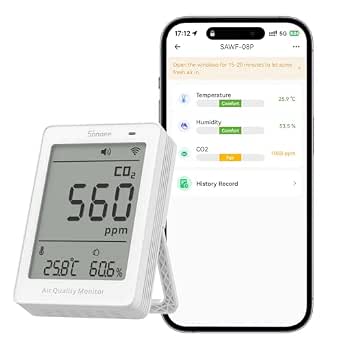 | Best for Matter Smart-Home Integration | Model: SAWF-08P | Measurements: CO2, temperature, humidity | Sensor type: NDIR | VIEW LATEST PRICE | See Our Full Breakdown |
| BREATHE Airmonitor Plus Gen 2 Indoor Air Quality Monitor |  | Best for Broad Pollutant Coverage | Model: BTL40001 | Measurements: CO2, PM1, PM2.5, PM10, TVOC, formaldehyde (HCHO), temperature, humidity | CO2 sensor: NDIR | VIEW LATEST PRICE | See Our Full Breakdown |
| GoveeLife H5140 Smart CO₂ Air Quality Monitor |  | Best for CO₂ Trend Tracking | Measurements: CO₂, temperature, humidity | CO₂ sensor: SCD4x photoacoustic NDIR | CO₂ accuracy: ±(40 ppm + 5%) | VIEW LATEST PRICE | See Our Full Breakdown |
| Aranet4 Indoor Air Quality Monitor with Wireless CO2 Detector |  | Best Battery-Powered CO₂ Monitor | Measurements: CO₂, temperature, relative humidity, atmospheric pressure | Sensor technology: NDIR | Display: E-ink | VIEW LATEST PRICE | See Our Full Breakdown |
| Amazon Smart Air Quality Monitor, 2-Pack | | Best for Alexa-Based Whole-Home Coverage | Pack size: 2 monitors | Monitored factors: PM2.5, VOCs, carbon monoxide, humidity, temperature | Connectivity: Alexa app and compatible Echo devices | VIEW LATEST PRICE | See Our Full Breakdown |
| Ring Air Quality Monitor with CO and PM2.5 Monitoring |  | Best for Ring and Sidewalk Households | Measurements: Carbon monoxide, PM2.5, temperature, humidity | Power: 100–240 VAC, 50/60 Hz | Connectivity: Amazon Sidewalk | VIEW LATEST PRICE | See Our Full Breakdown |
| 10-in-1 Portable Indoor Air Quality Monitor |  | Best Portable Multi-Reading Display | Brand and model: Lwyinp MT13 | Measurements: CO₂, HCHO, TVOC, AQI, PM2.5, PM1.0, PM10, temperature, humidity, time | Display: High-definition color screen with three-color air quality indicators | VIEW LATEST PRICE | See Our Full Breakdown |
| Smart CO2 Monitor with WiFi App, 10-in-1 Air Quality Monitor Indoor |  | Best for Remote Multi-Pollutant Monitoring | Connectivity: 2.4GHz WiFi | App: Tuya app for iOS and Android | Sensors: CO2, PM1.0, PM2.5, PM10, TVOC, HCHO, AQI, temperature, humidity | VIEW LATEST PRICE | See Our Full Breakdown |
| Airthings View Plus Radon & Air Quality Monitor |  | Best for Radon Monitoring | Model: 2960 | Connectivity: WiFi | Power: Battery | VIEW LATEST PRICE | See Our Full Breakdown |
| Lecoolife 16-in-1 Air Quality Monitor with 7″ Display and NDIR CO2 Sensor |  | Best for a Large At-a-Glance Display | Model: AK22B | Display: 7 inches, adjustable brightness | Sensors: NDIR CO2, PM1.0, PM2.5, PM10, HCHO, TVOC, temperature, humidity, AQI | VIEW LATEST PRICE | See Our Full Breakdown |
| GoveeLife Smart Air Quality Monitor H5106 with LED Display |  | Best for GoveeLife Automation | Model: H5106 | Measurements: PM2.5, temperature, humidity | Connectivity: Bluetooth and 2.4GHz WiFi | VIEW LATEST PRICE | See Our Full Breakdown |
| SONOFF SAWF-07P Smart Indoor Air Quality Monitor with PM2.5, PM10, Temperature and Humidity Sensors |  | Best for Matter Smart-Home Integration | Model: SAWF-07P | Measurements: PM2.5, PM10, temperature, humidity | Connectivity: 2.4GHz WiFi; Matter-compatible | VIEW LATEST PRICE | See Our Full Breakdown |
| smart air quality monitor | Connectivity | Power | Model | Measurements |
|---|---|---|---|---|
| Amazon Smart Air Quality Monit | 2.4GHz Wi-Fi and BLE 4.2 | 5.0V, 1A (5W) | — | — |
| Airthings Wave Plus Radon and | Bluetooth | 2 AA batteries | 2930 | — |
| Qingping Air Quality Monitor G | 2.4GHz and 5GHz Wi-Fi | — | CGS2 | — |
| SONOFF AirGuard CO2 SAWF-08P S | 2.4GHz Wi-Fi; Matter compatible | — | SAWF-08P | CO2, temperature, humidity |
| BREATHE Airmonitor Plus Gen 2 | 2.4GHz Wi-Fi | USB-C or battery | BTL40001 | CO2, PM1, PM2.5, PM10, TVOC, formaldehyde (HCHO), temperature, humidity |
| GoveeLife H5140 Smart CO₂ Air | App, Alexa, Google Assistant | AC via Type-C cable | — | CO₂, temperature, humidity |
| Aranet4 Indoor Air Quality Mon | — | — | — | CO₂, temperature, relative humidity, atmospheric pressure |
| Amazon Smart Air Quality Monit | Alexa app and compatible Echo devices | — | — | — |
| Ring Air Quality Monitor with | Amazon Sidewalk | 100–240 VAC, 50/60 Hz | — | Carbon monoxide, PM2.5, temperature, humidity |
| 10-in-1 Portable Indoor Air Qu | Bluetooth for time calibration | — | — | CO₂, HCHO, TVOC, AQI, PM2.5, PM1.0, PM10, temperature, humidity, time |
| Smart CO2 Monitor with WiFi Ap | 2.4GHz WiFi | — | — | — |
| Airthings View Plus Radon & Ai | WiFi | Battery | 2960 | — |
| Lecoolife 16-in-1 Air Quality | — | — | AK22B | — |
| GoveeLife Smart Air Quality Mo | Bluetooth and 2.4GHz WiFi | Wired Type-C cable; no built-in battery | H5106 | PM2.5, temperature, humidity |
| SONOFF SAWF-07P Smart Indoor A | 2.4GHz WiFi; Matter-compatible | Continuous power supply | SAWF-07P | PM2.5, PM10, temperature, humidity |
More Details on Our Top Picks
Amazon Smart Air Quality Monitor
Alexa automation is the main reason I’d choose this compact monitor: it tracks PM2.5, VOCs, carbon monoxide, humidity, and temperature, then can trigger compatible devices such as an air purifier through routines. Its color-coded LED gives a quick status check without opening an app, while Alexa notifications add a useful remote layer. Compared with the SONOFF AirGuard CO2, this model includes carbon monoxide and particulate monitoring but is much more tied to one smart-home ecosystem. It is also less informative about individual trends than the Qingping Air Quality Monitor Gen 2, which displays seven metrics and supports historical data. I’d pick Amazon’s monitor for straightforward household alerts, not for detailed analysis or flexible platform support.
Pros:- Tracks PM2.5, VOCs, carbon monoxide, humidity, and temperature.
- Alexa notifications and routines can connect readings to compatible smart devices.
- Color-coded LED provides an at-a-glance status check.
- Uses post-consumer recycled thermoplastic resin.
Cons:- Full app and automation features depend on the Alexa ecosystem.
- Requires a 2.4GHz Wi-Fi network.
- Indoor-only design limits placement.
Best for: Alexa households that want basic indoor air alerts and routines for compatible purifiers or other connected devices.
Not ideal for: Buyers who use Apple Home, Google Home, or a mixed smart-home setup, or who want detailed historical analytics and broad platform support.
- Tracked measurements:PM2.5, VOCs, carbon monoxide, humidity, temperature
- Connectivity:2.4GHz Wi-Fi and BLE 4.2
- Compatibility:Echo devices and Alexa app version 2021.16 or later
- Dimensions:65 × 65 × 45 mm
- Weight:120 g
- Power:5.0V, 1A (5W)
- Material:Post-consumer recycled thermoplastic resin
- Intended location:Indoor use only
- Warranty:One-year limited manufacturer’s warranty
Our verdict“Choose this monitor for simple, Alexa-centered alerts and automations, but pick a more platform-flexible model for broader smart-home support.”
Airthings Wave Plus Radon and Indoor Air Quality Monitor
Radon detection gives the Wave Plus a distinct role: it measures radon alongside CO2, VOCs, humidity, temperature, and air pressure, covering concerns that the Amazon Smart Air Quality Monitor does not address. Battery power and Bluetooth make placement flexible without needing a nearby outlet, and the app and online dashboard can turn readings into longer-term insight. The tradeoff is a seven-day sensor settling period, so it is not the pick for immediate, settled readings after setup. Its Bluetooth connection also makes app access less direct than the Wi-Fi monitoring offered by the BREATHE Airmonitor Plus Gen 2. Choose Airthings when radon is a priority and you can give the sensors time to adjust; skip it if you want broad particulate coverage or constant Wi-Fi access.
Pros:- Measures radon, CO2, VOCs, humidity, temperature, and air pressure.
- Battery-powered design allows placement away from outlets.
- Color-coded wave gesture gives a quick visual reading.
- App and online dashboard provide detailed insights and analytics.
Cons:- Sensors need a seven-day settling period.
- Bluetooth is required for smartphone app connection.
- Does not list particulate measurements such as PM2.5 or PM10.
Best for: Homeowners who want to monitor radon alongside CO2 and other indoor conditions, especially where flexible battery-powered placement matters.
Not ideal for: Buyers who need PM2.5 or PM10 readings, immediate readings after setup, or remote app access without Bluetooth proximity.
- Model:2930
- Sensors:Radon, CO2, VOCs, humidity, temperature, air pressure
- Power:2 AA batteries
- Battery life:Up to 16 months
- Connectivity:Bluetooth
- App compatibility:iOS and Android
- Sensor settling period:7 days
- Warranty:Optional five-year extended warranty; registration required within 30 days
Our verdict“Pick the Wave Plus if radon is a central concern; choose a Wi-Fi model such as the BREATHE Airmonitor Plus for particulate readings and more direct remote tracking.”
Qingping Air Quality Monitor Gen 2
The 4-inch touchscreen makes the Qingping the easiest option here to read across several metrics without reaching for a phone. It tracks seven measurements, including CO2, PM2.5, PM10, eTVOC, and noise, while Wi-Fi supports remote checks and 30-day history export. That gives it a more information-rich presentation than the Amazon Smart Air Quality Monitor, whose LED is better suited to a quick status glance than detailed readings. Unlike the BREATHE Airmonitor Plus Gen 2, however, Qingping does not measure formaldehyde, and its battery backup lasts only about three hours—enough for brief power interruptions, not portable monitoring. I’d choose it for a visible home dashboard; buyers wanting longer unplugged use or formaldehyde data should compare alternatives.
Pros:- Displays seven measurements, including PM2.5, PM10, CO2, eTVOC, and noise.
- Four-inch IPS touchscreen makes readings easy to view at a glance.
- Supports remote monitoring and 30-day historical data export.
- Replaceable PM sensor supports maintenance over time.
Cons:- Does not measure formaldehyde.
- Battery backup lasts only about three hours.
- USB power adapter is not included.
Best for: Households that want a large, always-visible display for multiple air readings plus app access to recent trends.
Not ideal for: Buyers who need formaldehyde readings, extended battery-powered monitoring, or a ready-to-use setup with a power adapter included.
- Model:CGS2
- Monitored metrics:Temperature, humidity, CO2, PM2.5, PM10, eTVOC, noise
- Display:4-inch IPS touchscreen, 254 PPI
- Connectivity:2.4GHz and 5GHz Wi-Fi
- Power source:USB, 5V 1A
- Battery backup:Up to 3 hours
- Weight:8.96 ounces
- Color:Black
Our verdict“Choose Qingping for a clear, information-dense home display, but look to BREATHE if formaldehyde monitoring or longer unplugged operation matters more.”
SONOFF AirGuard CO2 SAWF-08P Smart Indoor Air Quality Monitor
Matter compatibility is the AirGuard’s clearest advantage: it can fit into Apple Home, Alexa, Google Home, SmartThings, and Home Assistant setups, unlike the Alexa-focused Amazon Smart Air Quality Monitor. Its NDIR sensor tracks CO2, with temperature and humidity on the same display; a five-second response and stated accuracy give buyers a focused tool for spotting ventilation changes. The limitation is scope: it does not measure particulate matter, VOCs, or carbon monoxide, so the BREATHE Airmonitor Plus Gen 2 covers more kinds of air concerns. It also needs continuous power and 2.4GHz Wi-Fi. I’d choose SONOFF when cross-platform automation and CO2 trends matter more than broad pollutant coverage or battery flexibility.
Pros:- Matter support spans Apple Home, Alexa, Google Home, SmartThings, and Home Assistant.
- NDIR sensor measures CO2 with a stated response time of five seconds.
- Displays CO2, temperature, and humidity together.
- Supports 12 months of historical tracking and data export.
Cons:- Measures only CO2, temperature, and humidity.
- Requires continuous power for monitoring.
- Wi-Fi connectivity is limited to 2.4GHz.
Best for: Smart-home users who want CO2, temperature, and humidity readings integrated across Matter-compatible platforms.
Not ideal for: Buyers seeking radon, particulate, VOC, or carbon monoxide readings, or anyone who needs a battery-powered monitor.
- Model:SAWF-08P
- Measurements:CO2, temperature, humidity
- Sensor type:NDIR
- CO2 measuring range:400–5000 ppm
- CO2 accuracy:±(50 ppm + 5%)
- Temperature accuracy:±0.5 °C
- Response time:5 seconds
- Connectivity:2.4GHz Wi-Fi; Matter compatible
- Compatible platforms:Apple Home, Amazon Alexa, Google Home, SmartThings, Home Assistant
Our verdict“Choose the AirGuard for cross-platform CO2 monitoring and automation, but select BREATHE or Qingping for a wider set of air-quality measurements.”
BREATHE Airmonitor Plus Gen 2 Indoor Air Quality Monitor
Broad pollutant coverage puts the BREATHE Airmonitor Plus ahead of more focused choices: it tracks CO2, PM1, PM2.5, PM10, TVOC, formaldehyde, temperature, and humidity. Dedicated sensor types—including NDIR for CO2 and laser sensing for particles—are paired with app alerts, trend graphs, 90-day history, and CSV export. That makes it a stronger fit for users who want to review patterns than the SONOFF AirGuard CO2, which concentrates on CO2, temperature, and humidity. The Qingping Air Quality Monitor Gen 2 has a larger on-device touchscreen, while BREATHE’s distinguishing strength is its formaldehyde measurement and longer history. Tradeoffs include 2.4GHz-only Wi-Fi, indoor-only use, and no detection of carbon monoxide, gas leaks, or smoke.
Pros:- Tracks eight measurements, including PM1, PM2.5, PM10, TVOC, and formaldehyde.
- Uses dedicated sensors, including NDIR for CO2 and a laser particle sensor.
- App offers custom alerts, trend graphs, 90-day history, and CSV export.
- Can run unplugged for up to six hours.
Cons:- Does not detect carbon monoxide, gas leaks, or smoke.
- Wi-Fi connectivity is limited to 2.4GHz.
- Battery operation lasts up to six hours, so extended use requires USB-C power.
Best for: Households that want detailed tracking of particles, CO2, TVOC, and formaldehyde, with app alerts and exportable history.
Not ideal for: Buyers who need carbon monoxide, gas leak, or smoke detection, or who want a monitor that runs unplugged for long periods.
- Model:BTL40001
- Measurements:CO2, PM1, PM2.5, PM10, TVOC, formaldehyde (HCHO), temperature, humidity
- CO2 sensor:NDIR
- Connectivity:2.4GHz Wi-Fi
- App features:Remote readings, custom CO2 and PM2.5 alerts, trend graphs, 90-day history, CSV export
- Power:USB-C or battery
- Battery operation:Up to 6 hours unplugged
- Intended use:Indoor
- Manufacturer warranty:2 years
Our verdict“Choose BREATHE for wide pollutant coverage and exportable trends, but use separate safety alarms for carbon monoxide, smoke, and gas leaks.”
GoveeLife H5140 Smart CO₂ Air Quality Monitor
I’d choose the GoveeLife H5140 when the main question is whether ventilation is keeping CO₂ in check. Its SCD4x photoacoustic NDIR sensor refreshes every five seconds, while the app stores up to two years of history for spotting patterns or exporting data. Customizable buzzer, app, and email alerts give it more ways to flag a rise than the battery-powered Aranet4, whose history is limited to 90 days.
The tradeoff is a fixed spot near an outlet: the H5140 needs continuous AC power, and its clock appears only when connected to the app. Outdoor calibration may also be needed. It measures CO₂, temperature, and humidity, not particles or carbon monoxide, and it cannot command an air purifier to lower CO₂. I’d skip it if portable placement or broad pollutant coverage matters more than long-term CO₂ records.
Pros:- Tracks CO₂, temperature, and humidity with five-second refreshes.
- Stores up to two years of history and supports CSV export.
- Offers buzzer, app, and email alerts with adjustable display brightness.
- Works with Alexa and Google Assistant for voice queries and smart home linkage.
Cons:- Requires continuous AC power, limiting placement.
- Clock display depends on app connection, and outdoor calibration may be needed.
- Cannot link to an air purifier to reduce CO₂ and does not track particles or carbon monoxide.
Best for: Homeowners or office managers who want persistent CO₂ monitoring, customizable alerts, and long-term records for ventilation decisions.
Not ideal for: People who need a portable, battery-powered monitor or readings for PM2.5, VOCs, or carbon monoxide.
- Measurements:CO₂, temperature, humidity
- CO₂ sensor:SCD4x photoacoustic NDIR
- CO₂ accuracy:±(40 ppm + 5%)
- Refresh rate:5 seconds
- Power:AC via Type-C cable
- Connectivity:App, Alexa, Google Assistant
- Alerts:Built-in buzzer, app notifications, email reports
- Data history:Up to 2 years; CSV export
Our verdict“Pick the H5140 if detailed CO₂ history and flexible alerts matter more than cordless placement or broader pollutant sensing.”
Aranet4 Indoor Air Quality Monitor with Wireless CO2 Detector
The Aranet4 suits buyers who want CO₂ readings without tethering a monitor to an outlet. Its e-ink screen stays readable with low power use, and the included AA batteries can last up to four years. That makes it easier to place on a shelf or move between rooms than the AC-powered GoveeLife H5140. Color alerts and an optional buzzer also make a rising CO₂ level easier to notice without opening the app.
It measures temperature, relative humidity, and atmospheric pressure alongside CO₂, but its app history reaches only 90 days—far shorter than GoveeLife’s two-year record and CSV export. The Aranet4 also lacks the email alerts and voice assistant links listed for the H5140. I’d favor it for low-maintenance, cordless CO₂ monitoring, not for extensive data archiving or a wide range of pollutant readings.
Pros:- NDIR sensor monitors CO₂ in real time.
- E-ink display and included AA batteries support up to four years of battery life.
- Measures temperature, relative humidity, and atmospheric pressure as well as CO₂.
- Color alerts and optional buzzer flag elevated CO₂.
Cons:- App history is limited to 90 days.
- Runs on two AA batteries rather than continuous AC power.
- Does not offer the H5140’s stated email alerts, voice assistant links, or CSV export.
Best for: People who want a compact, cordless CO₂ monitor for bedrooms, classrooms, or shared workspaces with minimal battery changes.
Not ideal for: Buyers who need multi-year downloadable records, voice assistant integration, or readings for PM2.5 and VOCs.
- Measurements:CO₂, temperature, relative humidity, atmospheric pressure
- Sensor technology:NDIR
- Display:E-ink
- Battery life:Up to 4 years
- Batteries:2 AA batteries, included
- App history:Up to 90 days
- Dimensions:2.76 x 2.76 x 0.94 inches
- Weight:3.67 ounces
Our verdict“Choose the Aranet4 for long-lasting cordless CO₂ monitoring, but pick the GoveeLife H5140 if longer records and app-linked alerts take priority.”
Amazon Smart Air Quality Monitor, 2-Pack
I’d put this two-monitor Alexa bundle on the shortlist for households that want readings in more than one room and already use Echo devices. Each unit tracks PM2.5, VOCs, carbon monoxide, humidity, and temperature, a broader mix than the CO₂-focused GoveeLife H5140 or Aranet4. The Alexa app adds a color indicator and air quality score, while notifications and Routines can prompt compatible devices to respond when readings change.
The pair’s value is in room coverage and Alexa automation, not independence from Amazon’s ecosystem. Setup, monitoring, and automations rely on the Alexa app and compatible Echo devices; temperature and humidity readings are described for use with a compatible Amazon Smart Thermostat. Unlike the Ring monitor, which also tracks CO and PM2.5, this option adds VOCs and comes as a two-pack. I’d skip it if you want CO₂ readings or a platform-neutral monitor.
Pros:- Two monitors allow coverage across separate rooms.
- Tracks PM2.5, VOCs, carbon monoxide, humidity, and temperature.
- Alexa app provides color-coded indicators and an air quality score.
- Alerts and Routines can prompt compatible Alexa devices to respond.
Cons:- Monitoring and automation depend on the Alexa app and compatible Echo devices.
- Does not measure CO₂, unlike the GoveeLife H5140 and Aranet4.
- Temperature and humidity readings are described for use with a compatible Amazon Smart Thermostat.
Best for: Alexa households that want to monitor two indoor areas and trigger compatible devices from air quality changes.
Not ideal for: Buyers who need CO₂ measurements, non-Alexa app support, or standalone monitoring without Echo devices.
- Pack size:2 monitors
- Monitored factors:PM2.5, VOCs, carbon monoxide, humidity, temperature
- Connectivity:Alexa app and compatible Echo devices
- Alerts:Phone notifications and Echo announcements
- Automation:Alexa Routines for compatible devices
- Setup:Plug in and configure through the Alexa app
Our verdict“Choose this two-pack for Alexa-based monitoring across rooms, but skip it if CO₂ data or broader platform flexibility is a priority.”
Ring Air Quality Monitor with CO and PM2.5 Monitoring
The Ring Air Quality Monitor makes sense for Ring households that want carbon monoxide and PM2.5 readings in one powered indoor device. It also tracks temperature and humidity, and offers suggestions when conditions change. Amazon Sidewalk may help keep it connected in hard-to-reach areas, although coverage varies. Compared with the two-pack Amazon Smart Air Quality Monitor, this is a single-device choice focused on CO and particles rather than VOCs and Alexa room coverage.
Its limits matter: it is not a certified CO alarm, so it should not replace a dedicated safety alarm, and it does not measure CO₂ or radon. It also requires an outlet and indoor placement. The published ranges and accuracy figures help set expectations, but the stated PM2.5 and CO accuracy tolerances are broad. I’d choose it for Ring-linked environmental awareness, not as a complete air-quality or life-safety system.
Pros:- Monitors carbon monoxide, PM2.5, temperature, and humidity.
- Provides suggestions when conditions change.
- Amazon Sidewalk may help maintain connectivity in hard-to-reach areas.
- Can pair with compatible Ring environmental devices.
Cons:- Not certified as a carbon monoxide alarm or detector.
- Does not measure CO₂ or radon, unlike monitors focused on those readings.
- Requires indoor AC power, and Sidewalk coverage can vary.
Best for: Ring users who want indoor CO and PM2.5 awareness, along with temperature and humidity readings.
Not ideal for: People seeking a replacement for a certified CO alarm, or buyers who need CO₂, radon, or portable monitoring.
- Measurements:Carbon monoxide, PM2.5, temperature, humidity
- Power:100–240 VAC, 50/60 Hz
- Connectivity:Amazon Sidewalk
- PM2.5 range:0 to 500 µg/m³
- CO range:0 to 70 ppm
- PM2.5 accuracy:±20 µg/m³ or ±20%, whichever is greater
- CO accuracy:±5 ppm or ±30%, whichever is greater
- Dimensions:1.83 x 2.56 x 2.56 inches
- Limitations:Indoor use only; not a certified CO alarm; does not measure CO₂ or radon
Our verdict“Pick the Ring monitor for Ring-linked CO and PM2.5 awareness, but keep a separate certified CO alarm and look elsewhere for CO₂ readings.”
10-in-1 Portable Indoor Air Quality Monitor
The Lwyinp MT13 packs a wide set of readings into a compact screen: CO₂, formaldehyde, TVOC, AQI, PM2.5, PM1.0, PM10, temperature, and humidity, plus a clock. That makes it a more data-dense portable option than the outlet-bound GoveeLife H5140, which focuses on CO₂, temperature, and humidity, or the Aranet4, whose screen is e-ink and whose sensor list is narrower. Its color indicators help make threshold changes visible at a glance.
The feature count comes with a usability compromise. Time calibration requires a Bluetooth phone connection, while calibration and other settings rely on sequences of button presses. The supplied information does not specify a dedicated app, alert delivery, data history, or smart assistant support, so I wouldn’t choose it for connected monitoring or long-term trend analysis. It fits buyers who value a broad, on-device snapshot and portable placement over a polished smart-home experience.
Pros:- Displays CO₂, formaldehyde, TVOC, AQI, PM2.5, PM1.0, PM10, temperature, and humidity.
- Color screen and three-color indicators make readings and threshold changes visible.
- Portable design can move between homes, offices, vehicles, and other indoor spaces.
- Includes charging cable and user manual.
Cons:- Time calibration requires connecting a phone over Bluetooth.
- Calibration and other controls rely on sequences of button presses.
- Provided product details do not specify app alerts, data history, or smart assistant support.
Best for: People who want a portable monitor with a broad set of readings shown directly on a color screen for use across indoor spaces.
Not ideal for: Smart-home users who need app-based alerts, voice assistant links, or a documented long-term data history.
- Brand and model:Lwyinp MT13
- Measurements:CO₂, HCHO, TVOC, AQI, PM2.5, PM1.0, PM10, temperature, humidity, time
- Display:High-definition color screen with three-color air quality indicators
- Connectivity:Bluetooth for time calibration
- Controls:Power, temperature unit selection, sound, calibration, screen sleep
- Color:Black
- Included components:Air quality monitor, charging cable, user manual
Our verdict“Choose the MT13 for a portable, broad on-screen snapshot, but favor the GoveeLife H5140 or Aranet4 for documented connected CO₂ tracking.”
Smart CO2 Monitor with WiFi App, 10-in-1 Air Quality Monitor Indoor
This model makes the most sense for buyers who want to check several air-quality readings while away from home. Its 2.4GHz WiFi connection and Tuya app provide remote access, alerts, and 30-day history—a more connected approach than the display-focused Lecoolife 16-in-1, which emphasizes at-a-glance readings and manual calibration. The sensor list covers CO2, four particulate measures, TVOC, HCHO, temperature, humidity, and AQI, giving households more context than the narrower GoveeLife H5106, which focuses on PM2.5 and comfort readings.
The tradeoff is dependence on a compatible 2.4GHz network and the app for full functionality. I’d choose it for remote oversight, but not for someone who wants a largely standalone monitor or radon tracking like the Airthings View Plus provides.
Pros:- Remote monitoring and alerts through the Tuya app
- Tracks CO2, particulate matter, TVOC, HCHO, temperature, and humidity
- Provides 30-day historical data
- Pre-calibrated and designed for setup in about 60 seconds
Cons:- Requires a 2.4GHz WiFi network
- Full functionality depends on a smartphone app
- Does not list radon sensing, unlike the Airthings View Plus
Best for: Households that want remote alerts and a broad mix of pollutant readings through a phone app.
Not ideal for: Buyers without a 2.4GHz WiFi network or anyone who prefers local controls and a screen-first experience.
- Connectivity:2.4GHz WiFi
- App:Tuya app for iOS and Android
- Sensors:CO2, PM1.0, PM2.5, PM10, TVOC, HCHO, AQI, temperature, humidity
- Data history:30 days
- Calibration:Pre-calibrated
- Setup time:About 60 seconds
Our verdict“Choose this if you want broad pollutant coverage with remote app access; skip it if you need a self-contained monitor or radon readings.”
Airthings View Plus Radon & Air Quality Monitor
The View Plus earns its place by measuring radon alongside everyday air-quality indicators, including PM2.5, CO2, and VOCs. That makes it a stronger fit for buyers concerned about longer-term radon exposure than the Smart CO2 Monitor with WiFi App, whose listed sensors cover a wider set of particle sizes and chemicals but omit radon. Its battery-powered, cable-free design also allows placement away from outlets, while the customizable eInk display keeps readings visible without relying only on a phone.
The tradeoff is a cloud- and account-based setup: WiFi and the Airthings app are required for full use, and data is stored in the cloud. Compared with the screen-forward Lecoolife 16-in-1, this is less about displaying a broad range of measurements and more about adding radon and trend tracking. I’d pass if local-only data is a priority.
Pros:- Measures radon as well as PM2.5, CO2, and VOCs
- Battery-powered design supports flexible, cable-free placement
- Customizable eInk display and app-based trend analysis
- Includes a five-year extended warranty after registration
Cons:- Requires WiFi and a user account for operation
- Stores data in the cloud rather than offering local-only storage
- The listed sensor set does not include PM10 or HCHO
Best for: Homeowners who want to monitor radon along with particulate matter, CO2, and VOCs, especially in rooms without convenient outlets.
Not ideal for: People who avoid cloud accounts or need a monitor that works fully without WiFi and a smartphone app.
- Model:2960
- Connectivity:WiFi
- Power:Battery
- Sensors:Radon, PM2.5, CO2, VOC, humidity, temperature, pressure
- Display:Customizable eInk
- Operating temperature:4 to 40°C (39 to 104°F)
- Warranty:Five-year extended warranty with registration
Our verdict“Pick the View Plus if radon monitoring and flexible placement matter more than local data storage or a larger pollutant list.”
Lecoolife 16-in-1 Air Quality Monitor with 7″ Display and NDIR CO2 Sensor
The Lecoolife is the display-first pick in this group. Its 7-inch screen makes readings easier to scan across a room than the smaller screen on the SONOFF SAWF-07P, while the NDIR CO2 sensor and readings for particles, HCHO, TVOC, temperature, and humidity give it a wide indoor-air snapshot. A built-in buzzer can call attention to threshold alerts without requiring the remote-app approach used by the Smart CO2 Monitor with WiFi App.
That independence comes with upkeep: the product description calls for manual calibration, and it warns that touching sensors or exposing them to strong odors can affect accuracy. Unlike the Airthings View Plus, it does not list radon monitoring or cable-free battery operation. I’d favor it for a fixed desk or shared room where a large display matters; buyers wanting unattended trend access should compare app-connected options.
Pros:- Large 7-inch display with adjustable brightness
- NDIR CO2 sensing plus particulate, HCHO, and TVOC readings
- Built-in buzzer alerts when thresholds are exceeded
- Supports calibration and Celsius/Fahrenheit switching
Cons:- Manual calibration is needed to maintain consistent readings
- Sensor readings may be affected by handling or strong odors
- No battery power or app-based remote monitoring is listed
Best for: Home and office users who want a large, readable screen and audible alerts in a fixed monitoring spot.
Not ideal for: People seeking a low-maintenance monitor, battery-powered placement, or radon tracking.
- Model:AK22B
- Display:7 inches, adjustable brightness
- Sensors:NDIR CO2, PM1.0, PM2.5, PM10, HCHO, TVOC, temperature, humidity, AQI
- Weight:1.47 pounds
- Dimensions:7.91 × 5.71 × 2.91 inches
- Alerts:Built-in buzzer for hazardous air conditions
Our verdict“Choose the Lecoolife for a large, alert-equipped display, but look elsewhere if you want low-maintenance remote tracking or radon data.”
GoveeLife Smart Air Quality Monitor H5106 with LED Display
The H5106 is a focused monitor for buyers who care most about PM2.5, temperature, and humidity, rather than a broad inventory of gases. Readings refresh every two seconds, and Bluetooth plus 2.4GHz WiFi supports remote checks and data export. Its strongest distinction is integration with compatible GoveeLife appliances, which can respond automatically to air-quality conditions—a more direct route to device control than the SONOFF SAWF-07P, whose appeal centers on Matter-compatible smart-home platforms.
The narrower sensor set is a real limitation: unlike the Smart CO2 Monitor with WiFi App, it does not list CO2, VOC, or HCHO measurement. It also needs continuous power, so it cannot be placed as freely as the battery-powered Airthings View Plus. I’d choose it for a GoveeLife setup and PM2.5 tracking, not for a full indoor pollutant survey.
Pros:- PM2.5, temperature, and humidity readings refresh every two seconds
- Bluetooth and 2.4GHz WiFi support local and remote access
- Can trigger compatible GoveeLife appliances
- Supports 13-day graphs and export of data from the past two years
Cons:- Measures fewer pollutants than the Smart CO2 Monitor with WiFi App
- Requires continuous power and has no built-in battery
- 2.4GHz WiFi is required to display the time
Best for: GoveeLife appliance owners who want fast PM2.5 updates, remote monitoring, and compatible automatic controls.
Not ideal for: Buyers who need CO2, VOC, or formaldehyde readings, or want a battery-powered monitor.
- Model:H5106
- Measurements:PM2.5, temperature, humidity
- Connectivity:Bluetooth and 2.4GHz WiFi
- Response time:2 seconds
- Display:LED display with four air-quality indicator levels
- Power:Wired Type-C cable; no built-in battery
- Data storage:13-day graphs; export data from the past two years
Our verdict“Choose the H5106 if you already use GoveeLife devices and mainly want PM2.5 monitoring; skip it for broader gas sensing.”
SONOFF SAWF-07P Smart Indoor Air Quality Monitor with PM2.5, PM10, Temperature and Humidity Sensors
The SAWF-07P stands out for pairing a 3.73-inch display with Matter compatibility and a long app history. It tracks PM2.5, PM10, temperature, and humidity, with readings updating every two seconds; customizable sound, LED, and app alerts let buyers choose how they want to be notified. Compared with the GoveeLife H5106, it adds PM10 and offers Matter integration rather than focusing on control of GoveeLife appliances. Its 12 months of charting and export also exceed the H5106’s 13-day on-device graph period, though the GoveeLife listing separately allows export of data from the past two years.
The sensor coverage remains limited: there is no listed CO2, VOC, or radon measurement, unlike the Smart CO2 Monitor with WiFi App or Airthings View Plus. Continuous power is required, and temperature accuracy is specified at ±1°F. I’d pick it for a Matter-based setup, not as a complete air-pollutant monitor.
Pros:- Matter-compatible connectivity for smart-home integration
- Measures both PM2.5 and PM10 alongside temperature and humidity
- Customizable sound, LED, and app alerts
- Offers 12 months of charting and data export in the eWeLink app
Cons:- Requires a continuous power supply
- Does not list CO2, VOC, HCHO, or radon sensing
- Temperature accuracy is specified at ±1°F
Best for: Smart-home users who want Matter-compatible PM2.5 and PM10 alerts with long-term app charts.
Not ideal for: Buyers who need CO2, VOC, or radon readings, or want a monitor that operates without continuous power.
- Model:SAWF-07P
- Measurements:PM2.5, PM10, temperature, humidity
- Connectivity:2.4GHz WiFi; Matter-compatible
- Display:3.73-inch screen
- Response time:2 seconds
- Data history:12 months with charting and export
- Power:Continuous power supply
Our verdict“Choose the SAWF-07P for Matter integration and PM10 tracking, but select a broader sensor model if you need gases or radon.”
How We Picked
I ranked these smart air quality monitors by how well their sensors address common indoor concerns, including CO2, fine particles, radon, and other reported air-quality measures. I also weighed whether readings are easy to interpret and act on through a built-in screen, app, alerts, or smart-home connection. Portability, room-to-room usefulness, and whether a product has a clear monitoring focus mattered more than a long sensor list on its own.
The order favors models with a clear role and useful balance of coverage, usability, and smart features. Broad monitors rank well for buyers seeking more than ventilation feedback; focused CO2 devices rank higher for that specific task but lower as all-purpose air monitors. I also distinguished named, established product lines from generic multi-in-one listings, where a large measurement count or display does not by itself establish sensor accuracy or dependable app support. Buyers should check the exact model’s current specifications and compatibility before purchase.
Factors to Consider When Choosing Smart Air Quality Monitors
Before choosing, decide what question you want the monitor to answer: whether a room needs more ventilation, whether particles are elevated, or whether radon deserves attention. That decision narrows the field faster than comparing every sensor label. I’d also think about where readings will appear and what action you can take when an alert arrives.
Start With the Air Concern You Can Act On
A monitor is useful when its readings connect to a practical response. CO2 can help flag rooms that may need more outdoor air, while particle readings can help you notice changes associated with cooking, smoke, or dust. Radon is a different concern: it calls for a suitable measurement approach and follow-up rather than a quick ventilation adjustment alone. Avoid choosing a device simply because it lists the most measurements; some readings may be less relevant to your home or harder to interpret. Pick the main concern first, then treat extra sensors as a bonus rather than a substitute for the reading you need.
Match Sensor Breadth to Your Monitoring Plan
Broad coverage can be valuable if you want one device to track several types of indoor conditions, but it can also add complexity and make comparisons between models harder. A focused CO2 monitor may be the better tool for a bedroom, classroom, or home office where ventilation is the main question. If you need radon information, confirm that the model specifically measures it rather than assuming a general air-quality label covers it. For multiple rooms, think about whether you need several monitors or whether moving one device is practical. A single monitor describes the room where it sits, not every room in the home.
Choose How You Want to See and Use Readings
A display makes quick checks easier for family members and guests who may not open an app. An app can be more useful for notifications, trends, and checking conditions while away, but it adds dependence on a phone, account, and supported connection. Voice-assistant integration can make alerts part of an existing smart-home routine, though it does not replace a clear reading or a sensible response plan. Before buying, check whether the features you want work with your phone and smart-home setup. If the monitor will sit in a shared space, prioritize information people can understand at a glance.
Check Placement, Portability, and Power
Sensor readings are only useful if the monitor is placed where they reflect the air you care about. A unit beside a window, vent, stove, or purifier may capture local conditions rather than the room’s typical air. Portable designs can help compare rooms, but moving a monitor frequently may complicate trend tracking or require time for readings to settle. Check the product’s power method and whether a screen stays visible during normal use. Plan the location before buying, especially if the device needs a nearby outlet or a stable place away from direct airflow.
Treat Alerts as Prompts, Not Diagnoses
Alerts can draw attention to a change, but they do not automatically explain its cause or prescribe the right fix. A high reading may call for ventilation, source control, or a closer look at an activity in the room. Check which measurements can trigger notifications, whether thresholds are adjustable, and how the app presents changes over time. Avoid setting alerts so sensitively that routine fluctuations become noise you start ignoring. For serious concerns, use the monitor as one source of information and follow appropriate testing or professional guidance.
Look Beyond Sensor Count to Long-Term Use
Buying decisions should account for the experience after setup: app access, connectivity, calibration guidance, power needs, and whether readings remain easy to review. Generic multi-in-one products can advertise many measurements, yet a long list alone does not tell you how clearly each reading is explained or supported. Check the exact model name and current product documentation rather than relying on similar-looking listings. A simpler device with a measurement you trust and a display you actually check can be more useful than a crowded dashboard. Spend more when the additional sensor or integration solves a real need in your home.
Frequently Asked Questions
Is a CO2 monitor enough if I mainly want to improve ventilation?
It can be enough if your main goal is spotting rooms that may need more fresh air, since CO2 is often used as a ventilation indicator. It will not tell you everything about particles, radon, or other indoor pollutants. Choose a focused model such as the Aranet4 or a GoveeLife CO2 monitor when ventilation is the clear priority and you value a simpler reading. If you want broader awareness across several kinds of air concerns, compare those with a multi-sensor option. Decide what action you’ll take when the reading rises before paying for sensors you may not use.
Should I choose an air monitor with a screen or an app-only model?
A screen is useful when you want quick readings without unlocking a phone, particularly in a shared room or workspace. An app-centered model can be a better fit if you care more about remote checks, notifications, and reviewing changes over time. Some products offer both, but the quality and clarity of the display and app still matter. Think about who will look at the readings: an easy-to-read screen helps a household act on information, while a phone-based setup may suit a single user. Check which features require an account or compatible smart-home devices.
Can one monitor tell me whether the air is good throughout my home?
No single stationary monitor can represent every room, since air conditions can vary with occupancy, cooking, ventilation, and the location of pollution sources. Put a device in the room where you spend time or where you have a specific concern. A portable monitor can help you compare rooms, though frequent moves may make long-term trends less clear. If you need ongoing readings in several spaces, multiple units may be more practical than relocating one. Place each device away from direct drafts and local sources that could skew the reading.
Will a smart air quality monitor detect radon as well as CO2 and particles?
Only models that specifically list radon measurement are intended to monitor radon; a broad air-quality label does not imply radon sensing. In this roundup, the Airthings Wave Plus and View Plus are the clearest radon-focused choices. Their wider sensor coverage may suit buyers who want radon alongside other indoor readings, while a CO2 specialist serves a narrower ventilation role. Check the exact model’s specifications before purchase, since similarly named products can have different capabilities. Treat a monitor’s readings as guidance and follow applicable testing recommendations for radon concerns.
Are multi-in-one monitors with many listed measurements a safer choice?
Not by default. A high measurement count can sound reassuring, but it does not show how useful each sensor is, how readings are presented, or whether app support fits your needs. Start with the specific concern you want to track and verify that the model lists an appropriate sensor for it. Named product lines in this roundup make their main roles easier to compare, while generic multi-in-one listings call for closer specification checks. A focused, understandable monitor may be a better decision than a device with more measurements but less clarity about what they mean.
Conclusion
For the broadest mix of home monitoring needs, I’d choose the Airthings View Plus as best overall; the Wave Plus is another strong fit for buyers who prioritize radon and indoor air readings. My best value pick for a straightforward smart-home setup is the Amazon Smart Air Quality Monitor, while the standard Amazon model is also my best choice for beginners who want accessible alerts and Alexa integration. For a premium, portable focus on CO2, consider the Aranet4; for a visible, multi-reading display, compare the Qingping Gen 2 and Lecoolife 16-in-1. If your main need is ventilation feedback, choose a CO2 specialist rather than paying for broader sensing you may not use; if radon is the concern, select a model that explicitly measures it.