
Smart home air quality monitors can track different things, so the right choice depends on which risks and readings matter in your home. My best overall pick is the Airthings View Plus for its radon monitoring alongside broader air-quality tracking. The Aranet4 stands out for focused CO2 monitoring, while the Amazon Smart Air Quality Monitor is a straightforward option for Alexa-centered households. The main tradeoffs are sensor coverage versus simplicity, app and ecosystem compatibility, and whether you want a portable readout or connected alerts. Read on for a comparison of all 15 picks and guidance on choosing the right monitor for your rooms and routines.

Get wellness gear delivered free with Prime
- Fast, free delivery on millions of items
- Prime Video, Amazon Music and more included
- Member-only deals all year
Key Takeaways
- Sensor coverage separates the picks: the amazon.com/dp/B097YW5Q72?tag=luxedevicelab-20&ascsubtag=dc-1260074″ target=”_blank” rel=”nofollow sponsored noopener”>Airthings View Plus adds radon monitoring, while the Aranet4 focuses on CO2 and several multi-in-1 models combine readings such as PM2.5, TVOC, and humidity.
- CO2 specialists and broad-spectrum monitors solve different problems: the Aranet4 is a focused choice for ventilation awareness; multi-sensor units can show more categories but may require buyers to check what each sensor actually measures.
- Smart-home fit is not interchangeable: Amazon and Ring models are more relevant to households already using those ecosystems, while a display or standalone device may suit buyers who want readings without relying on voice-assistant routines.
- Portable displays trade automation for immediate visibility: models such as the ZEMEOLLO and Lecoolife AK22B suit room-to-room checks, while connected models are a better match for remote alerts and routines.
- Safety detection needs its own scrutiny: a monitor that reports CO or air-quality readings should not automatically replace a certified, dedicated life-safety alarm; check the specific device’s certification and intended use.
- Duplicate Amazon listings serve different setups: the two-pack favors monitoring more than one room, while the single Amazon monitor suits a one-room starting point.
| Kidde Smart Carbon Monoxide Detector with Indoor Air Quality Monitoring |  | Best for CO Safety with Air Quality Tracking | Model: COPDLQW | Power: 120V plug-in with two AA backup batteries | Connectivity: 2.4 GHz Wi-Fi | VIEW LATEST PRICE | See Our Full Breakdown |
| Indoor Air Quality Monitor with PM2.5, CO2, TVOC, HCHO, and Temperature and Humidity Sensors |  | Best for Broad Readings on a Portable Display | Measurements: PM1, PM2.5, PM10, CO2, HCHO, TVOC, AQI, temperature, and humidity | Battery capacity: 2000 mAh | Battery life: About 7 hours | VIEW LATEST PRICE | See Our Full Breakdown |
| Ring Air Quality Monitor with CO and PM2.5 Monitoring |  | Best Compact Pick for Amazon Sidewalk Homes | Dimensions: 1.83 x 2.56 x 2.56 inches | Connectivity: Amazon Sidewalk | Power: 100–240 VAC, 50/60 Hz | VIEW LATEST PRICE | See Our Full Breakdown |
| Amazon Smart Air Quality Monitor (2-Pack) |  | Best for Alexa Room-to-Room Coverage | Package quantity: 2 monitors | Monitored factors: PM2.5, VOCs, carbon monoxide, humidity, and temperature | Connectivity: Works with Alexa | VIEW LATEST PRICE | See Our Full Breakdown |
| AirWhisper 16-in-1 Indoor Air Quality Monitor | 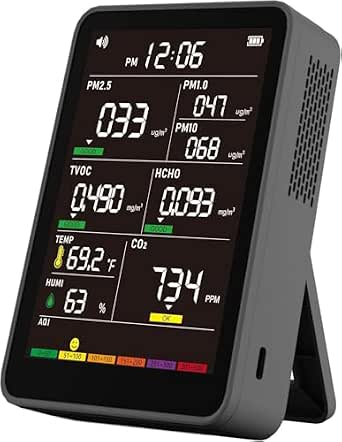 | Best for Fast, Frequent On-Device Updates | Measurements: PM1.0, PM2.5, PM10, CO2, TVOC, HCHO, temperature, and humidity | Update interval: 1.5 seconds | Runtime: 4–5 hours | VIEW LATEST PRICE | See Our Full Breakdown |
| ZEMEOLLO 10-in-1 Portable Indoor Air Quality Monitor | 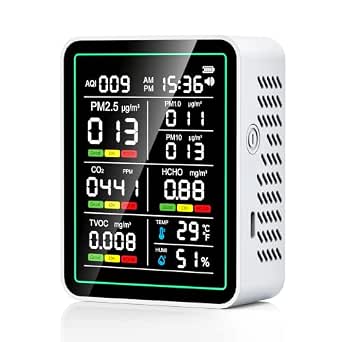 | Best Portable Multi-Metric Monitor | Measurements: CO₂, HCHO, TVOC, benzene, PM1.0, PM2.5, PM10, temperature, AQI, and time | Measurement error: Less than ±5% | Display: Color LED screen | VIEW LATEST PRICE | See Our Full Breakdown |
| Airthings View Plus Battery-Powered Radon and Air Quality Monitor |  | Best for Radon and Connected Whole-Home Tracking | Model: 2960 | Sensors: Radon, PM2.5, CO₂, VOCs, humidity, temperature, and air pressure | Connectivity: Wi-Fi | VIEW LATEST PRICE | See Our Full Breakdown |
| Aranet4 Indoor Air Quality Monitor with Wireless CO2 Detector |  | Best for Long-Life CO₂ Monitoring | Measurements: CO₂, temperature, relative humidity, and atmospheric pressure | Sensor technology: NDIR | Display: E-ink | VIEW LATEST PRICE | See Our Full Breakdown |
| GoveeLife H5106 Smart Air Quality Monitor with LED Display |  | Best for Remote PM2.5 Monitoring | Model: H5106 | Measurements: PM2.5, temperature, and humidity | PM2.5 accuracy: ±15 µg/m³ from 0 to 100 µg/m³; ±15% from 100 to 1000 µg/m³ | VIEW LATEST PRICE | See Our Full Breakdown |
| Amazon Smart Air Quality Monitor | | Best for Alexa-Connected Homes | Sensors: Temperature, humidity, carbon monoxide (CO), PM2.5, and VOCs | Dimensions: 65 × 65 × 45 mm | Weight: 120 g without cable or adapter | VIEW LATEST PRICE | See Our Full Breakdown |
| GoveeLife Smart Air Quality Monitor and CO₂ Detector H5140 |  | Best for CO₂-Focused Smart Alerts | Measurements: CO₂, temperature, and humidity | CO₂ sensor: SCD4x photoacoustic NDIR | CO₂ accuracy: ±(40 ppm + 5%) | VIEW LATEST PRICE | See Our Full Breakdown |
| Lwyinp 10-in-1 Indoor Air Quality Monitor |  | Best Portable No-App Display | Model: MT13S | Measurements: CO₂, HCHO, TVOC, temperature, humidity, AQI, PM1.0, PM2.5, and PM10 | Display: High-definition color screen with 3-color air-quality visualization | VIEW LATEST PRICE | See Our Full Breakdown |
| AprilAire ZAWTHCPV Smart Wi-Fi Indoor Air Quality Monitor |  | Best for AprilAire System Integration | Model: ZAWTHCPV | Measurements: PM2.5, VOCs, CO₂, humidity, and temperature | Connectivity: Wi-Fi | VIEW LATEST PRICE | See Our Full Breakdown |
| Lecoolife AK22B 16-in-1 Indoor Air Quality Monitor with 7-Inch Display |  | Best Large At-a-Glance Display | Model: AK22B | Measurements: CO₂, PM1.0, PM2.5, PM10, HCHO, TVOC, temperature, humidity, and AQI | Display: 7-inch full-view display with adjustable brightness | VIEW LATEST PRICE | See Our Full Breakdown |
| BREATHE Airmonitor Plus Gen 2 Indoor Air Quality Monitor |  | Best App-Connected Broad Coverage | Model: BTL40001 | Measurements: CO₂, PM1, PM2.5, PM10, TVOC, formaldehyde (HCHO), temperature, and humidity | CO₂ sensor: NDIR | VIEW LATEST PRICE | See Our Full Breakdown |
| smart home air quality monitor | Connectivity | Measurements |
|---|---|---|
| Kidde Smart Carbon Monoxide De | 2.4 GHz Wi-Fi | — |
| Indoor Air Quality Monitor wit | — | PM1, PM2.5, PM10, CO2, HCHO, TVOC, AQI, temperature, and humidity |
| Ring Air Quality Monitor with | Amazon Sidewalk | — |
| Amazon Smart Air Quality Monit | Works with Alexa | — |
| AirWhisper 16-in-1 Indoor Air | — | PM1.0, PM2.5, PM10, CO2, TVOC, HCHO, temperature, and humidity |
| ZEMEOLLO 10-in-1 Portable Indo | — | CO₂, HCHO, TVOC, benzene, PM1.0, PM2.5, PM10, temperature, AQI, and time |
| Airthings View Plus Battery-Po | Wi-Fi | — |
| Aranet4 Indoor Air Quality Mon | — | CO₂, temperature, relative humidity, and atmospheric pressure |
| GoveeLife H5106 Smart Air Qual | Bluetooth and 2.4 GHz Wi-Fi | PM2.5, temperature, and humidity |
| Amazon Smart Air Quality Monit | 2.4 GHz Wi-Fi and BLE 4.2 | — |
| GoveeLife Smart Air Quality Mo | App, Alexa, and Google Assistant | CO₂, temperature, and humidity |
| Lwyinp 10-in-1 Indoor Air Qual | Bluetooth for time calibration | CO₂, HCHO, TVOC, temperature, humidity, AQI, PM1.0, PM2.5, and PM10 |
| AprilAire ZAWTHCPV Smart Wi-Fi | Wi-Fi | PM2.5, VOCs, CO₂, humidity, and temperature |
| Lecoolife AK22B 16-in-1 Indoor | — | CO₂, PM1.0, PM2.5, PM10, HCHO, TVOC, temperature, humidity, and AQI |
| BREATHE Airmonitor Plus Gen 2 | 2.4 GHz Wi-Fi | CO₂, PM1, PM2.5, PM10, TVOC, formaldehyde (HCHO), temperature, and humidity |
More Details on Our Top Picks
Kidde Smart Carbon Monoxide Detector with Indoor Air Quality Monitoring
Safety-first monitoring is this Kidde’s main distinction: unlike the Ring Air Quality Monitor, it is a carbon monoxide detector with an 85 dB alarm, early alerts for low CO levels, and battery backup for outages. It also tracks temperature, humidity, and TVOCs, then sends real-time alerts through the app without requiring a subscription. That makes it a stronger fit for households that want CO protection alongside basic air-quality awareness than a portable display-focused monitor such as the AirWhisper 16-in-1.
The tradeoff is that its air-quality coverage is narrower: it does not list particulate matter or CO2 monitoring, and advanced trends require a paid subscription. It also needs 2.4 GHz Wi-Fi for app connectivity. I’d choose it for connected CO coverage, not as a substitute for a broad-spectrum air analyzer.
Pros:- Combines carbon monoxide detection with temperature, humidity, and TVOC monitoring
- Sends real-time app alerts without requiring a subscription
- AA battery backup helps maintain coverage during a power outage
- Works with Alexa and Google Home
Cons:- Does not monitor particulate matter or CO2
- Requires 2.4 GHz Wi-Fi for connected features
- Optional advanced air-quality insights and trends require a paid subscription
Best for: Households seeking a plug-in CO detector with app alerts, backup power, and a few added indoor air readings.
Not ideal for: Buyers who need PM2.5 or CO2 readings, or who want detailed air-quality trends without a subscription.
- Model:COPDLQW
- Power:120V plug-in with two AA backup batteries
- Connectivity:2.4 GHz Wi-Fi
- Monitors:Carbon monoxide, temperature, humidity, and TVOCs
- Alarm volume:85 dB
- Low-level CO alerts:30–70 ppm
- Smart home compatibility:Amazon Alexa and Google Home
- Warranty:10-year limited warranty
Our verdict“Choose the Kidde if connected carbon monoxide protection matters more than broad air-quality measurement.”
Indoor Air Quality Monitor with PM2.5, CO2, TVOC, HCHO, and Temperature and Humidity Sensors
Broad measurement coverage gives this Thrustmax monitor a different appeal from the Kidde detector: it lists PM1, PM2.5, PM10, CO2, HCHO, and TVOC, along with temperature and humidity. Its color screen puts readings and AQI in view on the device, while a buzzer can flag poor air quality without relying solely on phone notifications. Compared with the AirWhisper 16-in-1, it offers a similar portable, multi-sensor approach, with about seven hours of stated battery life rather than AirWhisper’s four to five.
That runtime still makes it better for spot checks than continuous, all-day cordless monitoring. The product description also gives conflicting “13-in-1” and “16-in-1” counts, so I’d focus on the listed sensors rather than the headline count. Choose it over the Ring monitor for its wider range of readings, but skip it if you need a dependable long-duration battery device.
Pros:- Lists particulate matter, CO2, HCHO, and TVOC measurements
- Color screen displays readings and AQI on the device
- AQI buzzer provides an audible alert
- Rechargeable battery supports about seven hours of operation
Cons:- About seven hours of battery life limits extended cordless use
- Description conflicts on whether the monitor is 13-in-1 or 16-in-1
- The supplied data does not state measurement accuracy
Best for: People who want to move a multi-sensor monitor between rooms and read AQI and individual measurements on-device.
Not ideal for: Buyers seeking continuous cordless monitoring throughout the day or a clearly documented measurement count.
- Measurements:PM1, PM2.5, PM10, CO2, HCHO, TVOC, AQI, temperature, and humidity
- Battery capacity:2000 mAh
- Battery life:About 7 hours
- Charging:USB Type-C
- Display:Color screen
- Alerts:AQI buzzer alert
- Item weight:14.1 ounces
- Manufacturer:Thrustmax
Our verdict“Pick this Thrustmax model for wide sensor coverage and a readable portable display, provided short battery sessions fit your routine.”
Ring Air Quality Monitor with CO and PM2.5 Monitoring
Small footprint and Amazon Sidewalk connectivity make the Ring monitor a focused choice for homes already within Sidewalk coverage. It tracks temperature, humidity, PM2.5, and CO, and offers suggestions for improving indoor air quality. Unlike the portable Thrustmax and AirWhisper monitors, it is designed as a compact, powered-in device rather than a battery-powered unit you carry from room to room. It also connects without a separate base station.
The key limitation is safety-related: it is not a certified CO alarm, so it should not replace a dedicated carbon monoxide detector such as the Kidde. Its sensor list is also narrower than those of the Thrustmax and AirWhisper, since it does not measure CO2 or radon. I’d choose Ring for compact monitoring and guidance within a compatible Amazon setup, not for comprehensive gas readings or stand-alone CO protection.
Pros:- Monitors PM2.5, carbon monoxide levels, temperature, and humidity
- Provides suggestions for improving indoor air quality
- Connects through Amazon Sidewalk without a separate base station
Cons:- Not a certified carbon monoxide alarm or detector
- Does not measure carbon dioxide or radon
- Availability of Amazon Sidewalk coverage varies by location
Best for: Amazon-connected households with Sidewalk coverage that want a compact monitor for PM2.5, CO levels, and room conditions.
Not ideal for: Anyone seeking a certified carbon monoxide alarm, CO2 or radon readings, or a monitor that works independently of Sidewalk coverage.
- Dimensions:1.83 x 2.56 x 2.56 inches
- Connectivity:Amazon Sidewalk
- Power:100–240 VAC, 50/60 Hz
- Monitors:Temperature, humidity, PM2.5, and CO
- PM2.5 measurement range:0 to 500 µg/m³
- CO measurement range:0 to 70 ppm
- Operating conditions:32°F to 120°F
- Warranty:One-year limited warranty
Our verdict“Choose Ring for compact air-quality guidance in a Sidewalk-covered Amazon home, but keep a certified CO alarm for safety.”
Amazon Smart Air Quality Monitor (2-Pack)
Two monitors in one package make this the lineup’s clearest choice for checking more than one room without moving a device around. Each tracks PM2.5, VOCs, carbon monoxide, humidity, and temperature, with air-quality information and alerts in the Alexa app. Unlike the single-room Ring monitor, this set is built for broader placement; compared with the Kidde, it adds particulate monitoring and Alexa Routines, but it is not presented as a dedicated CO alarm.
Its smart-home value depends on an Alexa setup: the app is needed for configuration and detailed readings, and automated responses require compatible Alexa devices. The supplied details also do not specify power, sensor accuracy, or whether the monitors operate independently of other Alexa equipment. I’d pick this two-pack for Alexa households that want room-level alerts and automations, not for buyers seeking a screen-first or standalone portable monitor.
Pros:- Includes two monitors for placement in separate rooms
- Tracks PM2.5, VOCs, carbon monoxide, humidity, and temperature
- Provides phone notifications or announcements on Echo devices
- Can trigger compatible devices through Alexa Routines
Cons:- Requires the Alexa app for setup and detailed air-quality information
- Climate-control automation depends on compatible Alexa devices
- Supplied product data does not specify power requirements or measurement accuracy
Best for: Alexa households that want to monitor air conditions in two rooms and use readings to trigger compatible devices.
Not ideal for: Buyers who do not use the Alexa app or lack compatible Alexa devices for automation.
- Package quantity:2 monitors
- Monitored factors:PM2.5, VOCs, carbon monoxide, humidity, and temperature
- Connectivity:Works with Alexa
- Alerts:Phone notifications or announcements on Echo devices
- Automation:Alexa Routines for compatible devices
Our verdict“Choose the two-pack if you want Alexa-linked readings and alerts in multiple rooms, and already use compatible devices.”
AirWhisper 16-in-1 Indoor Air Quality Monitor
Frequent updates and a color display make the AirWhisper useful for watching readings change during cooking, cleaning, or other short-term activities. It lists PM1.0, PM2.5, PM10, CO2, TVOC, HCHO, temperature, and humidity, and refreshes readings every 1.5 seconds. That makes it broader than the Ring monitor’s sensor set and more immediate in its display approach than the Alexa-focused Amazon two-pack, which emphasizes app alerts and routines instead.
Its one-button controls, switchable audio prompt, and USB-C charging keep operation straightforward, but the four-to-five-hour runtime limits cordless use. The product data also does not specify measurement accuracy, so I would treat it as a practical indicator rather than assume lab-grade precision. I’d choose the AirWhisper over the Thrustmax when faster stated updates matter more than battery endurance; choose the Thrustmax for its longer stated runtime.
Pros:- Lists particulate, gas, temperature, and humidity measurements
- Updates readings every 1.5 seconds on a color display
- Portable design can be used in rooms or vehicles
- Includes USB-C charging cable and AC power adapter
Cons:- Four-to-five-hour runtime requires frequent recharging for cordless use
- Product data does not specify measurement accuracy
Best for: People who want a portable, display-led monitor for observing short-term air changes and checking several readings at a glance.
Not ideal for: Buyers who need all-day cordless operation, documented measurement accuracy, or a dedicated CO alarm.
- Measurements:PM1.0, PM2.5, PM10, CO2, TVOC, HCHO, temperature, and humidity
- Update interval:1.5 seconds
- Runtime:4–5 hours
- Charging:USB Type-C
- Display:HD color screen
- Dimensions:1.6 × 5.3 × 6.7 inches
- Weight:12.3 ounces
- Warranty support:12 months
Our verdict“Pick the AirWhisper for fast, glanceable updates in a portable format, as long as its short battery runtime suits your use.”
ZEMEOLLO 10-in-1 Portable Indoor Air Quality Monitor
The ZEMEOLLO is the most travel-ready choice here for buyers who want a broad snapshot of air conditions without leaving the monitor plugged in. It tracks CO₂, formaldehyde, TVOC, benzene, and several particle sizes, then presents readings and alerts on a color screen. That coverage is wider than the GoveeLife H5106, which focuses on PM2.5, temperature, and humidity, and the rechargeable battery makes it easier to move between rooms, cars, or temporary workspaces.
The tradeoff is that the product details do not give individual sensor detection ranges, making it harder to judge the limits of each reading. Its battery is rated for up to 20 hours, so it is portable rather than a set-and-forget, always-on monitor. I’d choose it for mobile checks, not as a substitute for a continuously powered smart-home setup.
Pros:- Tracks a broad mix of gases, particulate sizes, and environmental readings
- Color screen displays measurements and air-quality alerts directly on the device
- Rechargeable battery supports up to 20 hours of use
- Portable design and one-button operation suit spot checks in different locations
Cons:- Individual sensor detection ranges are not specified in the provided product details
- Up to 20 hours of battery life means regular recharging for frequent mobile use
- Temperature starts in Celsius and requires a button press to change units
Best for: People who want to carry one monitor between rooms, vehicles, schools, or temporary workspaces and track multiple gases as well as particles.
Not ideal for: Buyers who need a continuously running monitor with clearly documented detection ranges or app-based remote tracking.
- Measurements:CO₂, HCHO, TVOC, benzene, PM1.0, PM2.5, PM10, temperature, AQI, and time
- Measurement error:Less than ±5%
- Display:Color LED screen
- Battery:2000mAh rechargeable; up to 20 hours
- Charging:USB charging cable included
- Temperature units:Celsius and Fahrenheit
- Suitable locations:Home, cars, schools, and hotels
Our verdict“Choose the ZEMEOLLO if portable checks across multiple locations matter more than app connectivity or continuous operation.”
Airthings View Plus Battery-Powered Radon and Air Quality Monitor
The View Plus has a distinctive advantage in this group: it monitors radon alongside PM2.5, CO₂, VOCs, humidity, temperature, and air pressure. That makes it a stronger fit than the Aranet4 for households that want radon readings and app-based trend tracking, rather than a focused CO₂ monitor. Its battery-powered design also frees placement from a nearby outlet, while the customizable eInk display keeps selected readings visible at a glance.
This wider view comes with a connectivity tradeoff. Live readings, alerts, and trends rely on the Airthings app, an account, and internet access, and readings are saved to the cloud. Compared with the plug-in Amazon Smart Air Quality Monitor, it covers more indicators and can connect with other Airthings monitors, but it is less appealing to buyers who want Alexa-centered routines or prefer not to depend on cloud services.
Pros:- Tracks radon as well as six other air-quality and environmental indicators
- Battery-powered design allows placement without a power cable
- App supports live readings, alerts, and trend tracking
- Can connect with other Airthings monitors for multi-room monitoring
Cons:- App features require an account and an internet connection
- Readings are saved to the cloud
- Using it across several rooms may mean buying additional compatible monitors
Best for: Households that want to monitor radon alongside common air-quality indicators and review readings across multiple rooms through an app.
Not ideal for: People who want offline monitoring, avoid cloud-stored readings, or want smart-home alerts centered on Alexa.
- Model:2960
- Sensors:Radon, PM2.5, CO₂, VOCs, humidity, temperature, and air pressure
- Connectivity:Wi-Fi
- Power:Battery-powered
- Display:Customizable eInk screen
- Operating temperature:4 to 40°C / 39 to 104°F
- Sensor type:Electrochemical
- Warranty:Optional extended warranty up to five years; registration required within 30 days
Our verdict“Pick the View Plus if radon monitoring and connected, multi-room trend tracking matter more than offline access or Alexa integration.”
Aranet4 Indoor Air Quality Monitor with Wireless CO2 Detector
The Aranet4 is the focused pick for buyers whose main question is whether indoor CO₂ is building up. Its NDIR CO₂ sensor is paired with temperature, humidity, and atmospheric pressure readings, while color-coded alerts and an optional buzzer make rising levels easier to notice without constantly checking an app. The four-year battery life is a major practical difference from the ZEMEOLLO, which offers broader gas and particle coverage but needs recharging much more often.
This narrow focus is also its limit: unlike the Airthings View Plus, it does not measure radon, PM2.5, or VOCs. Its e-ink display and app history suit people who want persistent readings and up to 90 days of graphs, but the historical window is finite and the monitor relies on two AA batteries. I’d select it for ventilation awareness, not as an all-in-one pollution monitor.
Pros:- NDIR sensor provides real-time CO₂ monitoring
- Up to four years of battery life reduces routine power upkeep
- Color-coded alerts and an optional buzzer make elevated readings easier to spot
- App offers graphs and up to 90 days of historical data
Cons:- Does not measure radon, VOCs, or particulate matter
- Uses two AA batteries rather than a rechargeable battery
- App history is limited to up to 90 days
Best for: People who want to track CO₂ and ventilation in a home office, classroom, or shared room with minimal battery maintenance.
Not ideal for: Buyers who need radon, VOC, or particulate monitoring in the same device, or who want longer app history.
- Measurements:CO₂, temperature, relative humidity, and atmospheric pressure
- Sensor technology:NDIR
- Display:E-ink
- Battery life:Up to four years
- Batteries:Two AA batteries included
- App history:Up to 90 days
- Dimensions:2.76 × 2.76 × 0.94 inches
- Weight:3.67 ounces
Our verdict“Choose the Aranet4 for long-running CO₂ and ventilation tracking, but choose the Airthings View Plus for broader pollutant coverage.”
GoveeLife H5106 Smart Air Quality Monitor with LED Display
The H5106 suits buyers who care most about PM2.5, temperature, and humidity and want to check those readings remotely. Measurements refresh every two seconds, and Bluetooth or 2.4 GHz Wi-Fi supports remote monitoring and data export. That makes it a more connected choice than the battery-powered Aranet4 for particle tracking; Aranet’s strength is CO₂ and long battery life, while this GoveeLife focuses on fine particles and room conditions.
Its smart features depend on a constant USB-C power connection, so it is less flexible to place than the battery-powered Airthings View Plus. GoveeLife appliance integrations can support automation, but only with listed compatible devices. The monitor also does not measure CO₂, radon, or VOCs, so it works best as a targeted PM2.5 monitor rather than a broad air-quality station.
Pros:- Tracks PM2.5, temperature, and humidity with readings refreshing every two seconds
- Bluetooth and 2.4 GHz Wi-Fi support local and remote monitoring
- Data can be exported for up to two years
- Can automate compatible GoveeLife appliances
Cons:- Requires continuous USB-C power and has no built-in battery
- Does not measure CO₂, radon, or VOCs
- Appliance integrations are limited to listed compatible GoveeLife devices
Best for: GoveeLife users who want remote PM2.5, temperature, and humidity readings with data export and compatible appliance automation.
Not ideal for: People who need a battery-powered monitor, CO₂ or radon readings, or compatibility beyond listed GoveeLife devices.
- Model:H5106
- Measurements:PM2.5, temperature, and humidity
- PM2.5 accuracy:±15 µg/m³ from 0 to 100 µg/m³; ±15% from 100 to 1000 µg/m³
- Temperature accuracy:±0.54°F
- Humidity accuracy:±3% RH
- Response time:2 seconds
- Connectivity:Bluetooth and 2.4 GHz Wi-Fi
- Power and data:Wired USB-C; 13-day graphs and export up to two years of data
Our verdict“Pick the H5106 for connected PM2.5 tracking and exportable data if a permanent outlet location and its narrower sensor range suit your setup.”
Amazon Smart Air Quality Monitor
The Amazon Smart Air Quality Monitor is the easiest fit for a home already organized around Alexa. It tracks temperature, humidity, carbon monoxide, PM2.5, and VOCs, then uses a color-coded LED and the Alexa app to show conditions and send alerts. Compatible Alexa routines can trigger climate-control devices, giving it a practical automation advantage over the Aranet4, which focuses on CO₂, temperature, humidity, and pressure rather than Alexa-based routines.
The tradeoff is ecosystem dependence: smart features require the Alexa app and compatible Echo or Alexa devices, and the monitor needs a power connection. It also does not measure CO₂ or radon, unlike the Airthings View Plus, so it is not the right pick for those specific concerns. I’d choose it for straightforward room monitoring and Alexa automations, not for broad pollutant coverage or cable-free placement.
Pros:- Tracks temperature, humidity, carbon monoxide, PM2.5, and VOCs
- Can send phone notifications and Echo announcements when air quality drops
- Supports Alexa routines with compatible climate-control devices
- Plug-in setup works through the Alexa app
Cons:- Smart features depend on the Alexa app and compatible Echo or Alexa devices
- Requires a power connection rather than offering battery-powered placement
- Does not measure CO₂ or radon
Best for: Alexa households that want basic indoor air readings, phone or Echo alerts, and routines for compatible climate-control devices.
Not ideal for: People without an Alexa setup, buyers who need CO₂ or radon readings, or anyone seeking a battery-powered monitor.
- Sensors:Temperature, humidity, carbon monoxide (CO), PM2.5, and VOCs
- Dimensions:65 × 65 × 45 mm
- Weight:120 g without cable or adapter
- Connectivity:2.4 GHz Wi-Fi and BLE 4.2
- Power:5 W; 100–240 V AC input, 5.0 V 1 A output
- Operating range:0°C to 40°C; 0% to 80% humidity
- Compatibility:Echo devices and Alexa app version 2021.16 or later
- Included:Monitor, Micro-USB cable, power adapter, and Quick Start Guide
Our verdict“Choose this monitor for simple readings and automation in an Alexa home, but look to the Airthings View Plus for radon or the Aranet4 for CO₂.”
GoveeLife Smart Air Quality Monitor and CO₂ Detector H5140
I’d choose the GoveeLife H5140 for rooms where changing CO₂ levels are the main concern and you want alerts without watching a screen. It measures CO₂, temperature, and humidity, then can send buzzer, app, or email notifications; Alexa and Google Assistant support also lets it fit into a voice-controlled home. Its five-second refresh rate and up-to-two-year history make it more useful for spotting patterns than a basic glance-only monitor. Compared with the AprilAire ZAWTHCPV, it offers longer stated data history and CSV export, but AprilAire tracks PM2.5 and VOCs as well. The tradeoff is a narrower set of air pollutants: this GoveeLife does not list particulate or VOC sensing. It also needs AC power, and app setup is required for clock display and feature configuration.
Pros:- Measures CO₂, temperature, and humidity in one device.
- Offers buzzer, app, and email alerts.
- Stores up to two years of history and supports CSV export.
- Works with Alexa and Google Assistant.
Cons:- Does not measure particulate matter, VOCs, or formaldehyde.
- Requires continuous AC power, limiting placement away from outlets.
- Clock display and feature configuration require an app connection.
Best for: Households that want frequent CO₂ updates, customizable alerts, and long-term data they can export for ventilation decisions.
Not ideal for: Buyers who need particulate or VOC readings, battery portability, or a monitor that works independently of an app setup.
- Measurements:CO₂, temperature, and humidity
- CO₂ sensor:SCD4x photoacoustic NDIR
- CO₂ accuracy:±(40 ppm + 5%)
- Refresh rate:5 seconds
- Connectivity:App, Alexa, and Google Assistant
- Data history:Up to 2 years; CSV export supported
- Power:AC power
- Included components:Air quality monitor and Type-C cable
Our verdict“Choose the GoveeLife H5140 if CO₂ alerts and extended, exportable history matter more than broad pollutant coverage or portability.”
Lwyinp 10-in-1 Indoor Air Quality Monitor
The Lwyinp MT13S suits buyers who want a broad set of readings on a portable screen rather than a monitor built around smart-home automations. It displays CO₂, formaldehyde, TVOC, AQI, temperature, humidity, and three particle sizes, with a three-color air-quality visualization that makes the readout easier to scan. Unlike the app-centered BREATHE Airmonitor Plus Gen 2, its listed Bluetooth use is limited to time calibration; the provided details do not describe remote readings, alerts, or history. That simpler approach may appeal if you want local readings and the option to move the unit between rooms, an office, or a vehicle. The tradeoff is less connected functionality and no stated measurement accuracy or battery runtime, so I would not pick it for detailed trend analysis or dependable remote monitoring.
Pros:- Displays CO₂, HCHO, TVOC, AQI, and PM1.0, PM2.5, and PM10 readings.
- Color screen gives a quick visual cue alongside the measurements.
- Rechargeable setup supports portable placement.
- Offers adjustable temperature units and sound controls.
Cons:- Bluetooth is described only for time calibration, with no listed remote monitoring or alert features.
- The supplied details do not state measurement accuracy or battery runtime.
- No historical data or export feature is listed.
Best for: People who want a portable, on-device overview of several air measurements for occasional use across rooms, an office, or a vehicle.
Not ideal for: Smart-home users who need Wi-Fi, remote alerts, historical graphs, or clear published accuracy and battery-runtime details.
- Model:MT13S
- Measurements:CO₂, HCHO, TVOC, temperature, humidity, AQI, PM1.0, PM2.5, and PM10
- Display:High-definition color screen with 3-color air-quality visualization
- Connectivity:Bluetooth for time calibration
- Power:Rechargeable; charging cable included
- Temperature units:Adjustable
- Sound controls:Adjustable
- Included items:Monitor, charging cable, and user manual
Our verdict“Pick the Lwyinp MT13S for portable, on-device breadth, but choose BREATHE if app-based alerts and trend history are priorities.”
AprilAire ZAWTHCPV Smart Wi-Fi Indoor Air Quality Monitor
The AprilAire ZAWTHCPV is the most system-oriented choice here: it tracks PM2.5, VOCs, CO₂, humidity, and temperature, then brings readings, trends, guidance, and alerts into the AprilAire Healthy Air App. That wider mix gives it an advantage over the GoveeLife H5140 if particulate and VOC conditions matter alongside CO₂. Its strongest reason to choose it, though, is its potential to work with compatible AprilAire filtration or ventilation equipment. That connection is not turnkey: a compatible Wi-Fi thermostat and mitigation equipment are sold separately. Buyers who only want a standalone monitor may get more straightforward value from the BREATHE Airmonitor Plus Gen 2, whose app features include data export. AprilAire’s three-year warranty is a plus, but the app requirement and ecosystem dependencies make this a better fit for homes already invested in AprilAire products.
Pros:- Tracks PM2.5, VOCs, CO₂, humidity, and temperature.
- App provides alerts, trends, and guidance.
- Can integrate with compatible AprilAire systems.
- Includes a three-year warranty.
Cons:- Requires the AprilAire Healthy Air App.
- Compatible Wi-Fi thermostat and mitigation equipment are sold separately.
- No data export or battery operation is listed.
Best for: Homeowners using compatible AprilAire ventilation or filtration equipment who want readings and guidance in the brand’s app.
Not ideal for: Buyers seeking a stand-alone monitor with broad app flexibility or a complete, out-of-box connection to mitigation equipment.
- Model:ZAWTHCPV
- Measurements:PM2.5, VOCs, CO₂, humidity, and temperature
- Connectivity:Wi-Fi
- App:AprilAire Healthy Air App
- App features:Readings, trends, guidance, and alerts
- System integration:Compatible AprilAire filtration or ventilation systems; compatible Wi-Fi thermostat required and sold separately
- Indicator lights:Three settings
- Warranty:3 years
- Included:Healthy Air Monitor and power supply
Our verdict“Choose AprilAire if you want its readings tied to a compatible AprilAire air-treatment setup; for a more self-contained app monitor, compare BREATHE.”
Lecoolife AK22B 16-in-1 Indoor Air Quality Monitor with 7-Inch Display
If readings need to be visible across a desk or room, the Lecoolife AK22B makes a stronger case than the smaller-screen Lwyinp MT13S: its seven-inch display presents a broad set of measurements at once, including CO₂, particles, HCHO, TVOC, temperature, humidity, and AQI. Adjustable brightness and a muteable buzzer help adapt it to a bedroom, office, or shared space, while calibration support gives owners a way to address readings over time. This is a local-display-first pick, not a connected smart-home hub; the product details do not list app, Wi-Fi, or voice-assistant support. There is also no published measurement accuracy, and the description warns that perfumes or strong odors can affect sensor accuracy. I’d favor it for visibility over remote tracking, where BREATHE or AprilAire offers more clearly defined app features.
Pros:- Seven-inch display presents multiple readings at a glance.
- Measures CO₂, PM1.0, PM2.5, PM10, HCHO, TVOC, temperature, humidity, and AQI.
- Brightness can be adjusted and buzzer alerts can be muted.
- Includes calibration support and °F/°C display options.
Cons:- No app, Wi-Fi, or voice-assistant features are listed.
- Measurement accuracy details are not provided.
- Strong odors such as perfume may affect sensor accuracy.
Best for: Households or small offices that want many readings visible on a large, adjustable screen without relying on a phone.
Not ideal for: Buyers who need app access, smart-speaker integration, published accuracy figures, or readings unaffected by nearby strong odors.
- Model:AK22B
- Measurements:CO₂, PM1.0, PM2.5, PM10, HCHO, TVOC, temperature, humidity, and AQI
- Display:7-inch full-view display with adjustable brightness
- Alerts:Buzzer alerts with mute function
- Calibration:Built-in calibration support
- Temperature units:°F and °C
- Time format:12-hour and 24-hour
- Item weight:1.47 pounds
Our verdict“Choose the Lecoolife AK22B for a large, information-dense local display, not for remote smart-home monitoring.”
BREATHE Airmonitor Plus Gen 2 Indoor Air Quality Monitor
The BREATHE Airmonitor Plus Gen 2 is the most balanced app-connected option in this group for buyers who want broad measurements plus a usable record of changing conditions. It tracks CO₂, PM1, PM2.5, PM10, TVOC, formaldehyde, temperature, and humidity; the app adds remote readings, configurable alerts, graphs, and CSV export for up to 90 days of history. Compared with the AprilAire ZAWTHCPV, BREATHE offers a defined export function and does not depend on an AprilAire treatment-system ecosystem. It also has a rechargeable battery, though up to six hours is better suited to moving it temporarily than leaving it untethered all day. Continuous USB-C power works for fixed placement. The tradeoffs are its 2.4 GHz Wi-Fi requirement and shorter stated history than the GoveeLife H5140.
Pros:- Measures eight air-quality and environmental indicators, including CO₂, particles, TVOC, and formaldehyde.
- App provides remote readings, configurable alerts, historical graphs, and CSV export.
- Stores up to 90 days of data.
- Can run from its rechargeable battery or USB-C power.
Cons:- Battery life is up to six hours, limiting untethered use.
- App connectivity requires 2.4 GHz Wi-Fi.
- Its stated data history is shorter than the GoveeLife H5140’s.
Best for: People who want broad pollutant coverage, app alerts, and exportable trend data, with occasional short-term portability.
Not ideal for: Buyers who need all-day battery operation, longer stored history, or connectivity that does not depend on 2.4 GHz Wi-Fi.
- Model:BTL40001
- Measurements:CO₂, PM1, PM2.5, PM10, TVOC, formaldehyde (HCHO), temperature, and humidity
- CO₂ sensor:NDIR
- Connectivity:2.4 GHz Wi-Fi
- App features:Remote readings, configurable alerts, historical graphs, and CSV data export
- Data history:Up to 90 days
- Battery life:Up to 6 hours
- Power:Rechargeable; USB-C power for continuous use
- Warranty:2 years
Our verdict“Pick BREATHE for app-based monitoring and exportable records across many pollutants, provided short battery life and 2.4 GHz Wi-Fi fit your setup.”

How We Picked
I compared these monitors by the usefulness of their stated sensors, the clarity of their readouts, how they connect to smart-home systems, and how well their format fits everyday use. I gave weight to practical distinctions: a radon-capable monitor answers a different household question than a CO2-only device, and a wide sensor list matters only when the readings are relevant and understandable. I also considered portability, display size, app-based access, and whether the product is positioned for a single room or broader home coverage.
The ranking favors products with a clear role and a useful balance of monitoring and usability, rather than rewarding the longest sensor list alone. The Airthings View Plus leads for its distinctive radon capability and broader monitoring scope; the Aranet4 earns a focused role for CO2; and Amazon’s monitor suits Alexa users who value simple connected monitoring. Other picks rank by how well their specific advantages match a buyer’s priorities, with tradeoffs such as ecosystem dependence, limited sensor scope, or a less connected portable format made explicit.
Factors to Consider When Choosing Smart Home Air Quality Monitors
Before choosing among smart home air quality monitors, decide what information you need and what you plan to do with it. A device with many readings is not automatically more useful than a focused monitor, and connectivity matters only if you will use its alerts or integrations. These broader checks can help prevent mismatched expectations.
Match Sensors to the Problem You Want to Track
Start with the concern behind your search: ventilation, particles, radon, carbon monoxide, or general indoor conditions. CO2 readings can help flag when a room may need more ventilation, but they do not measure every pollutant. PM2.5, TVOC, formaldehyde, and radon each describe different concerns, so a long sensor list is useful only if it includes the readings you need. Check product documentation for exactly which sensors are present and how readings are presented. Avoid treating an air-quality index as a substitute for specific pollutant measurements. If a particular hazard is your priority, choose a device designed and specified to measure it rather than relying on a broad label.
Separate Monitoring From Life-Safety Alarms
Air monitoring and life-safety detection are related but not interchangeable jobs. A monitor that displays carbon monoxide data may not serve the same role as a certified CO alarm, and its notifications may depend on power, connectivity, or app settings. Check the device’s stated purpose, relevant safety certification, alarm behavior, and installation guidance before relying on it for hazard protection. Keep required smoke and CO alarms in place even when adding a smart monitor. For radon or other concerns that call for formal measurement, follow local public-health guidance and the device maker’s instructions. This distinction matters more than the number of sensors on the box.
Check Smart-Home Compatibility Before You Buy
Connected features can make readings easier to act on, but compatibility varies by ecosystem and device. Confirm whether the monitor works with the assistant, app, or automation platform you already use, and check whether remote access or alerts require an account or internet connection. A device built around Alexa may be convenient in an Alexa household but less useful if the rest of your setup uses another platform. Ask whether it can trigger routines or only display readings; those are different levels of integration. If you prefer not to depend on cloud services, prioritize a clear local display and understand what functions remain available offline. Choosing for your existing setup can matter more than adding another connected feature.
Choose Between Room-to-Room Readings and Continuous Coverage
A portable monitor can help compare a bedroom, living area, or workspace, but moving one unit means you are not watching every room at once. A multi-unit setup or two-pack provides simultaneous coverage, though it adds more devices to configure and maintain. Think about where people spend time and where readings are most likely to change, such as a regularly occupied office or bedroom. Avoid placing a monitor right beside a window, vent, cooking area, or humidifier unless you specifically want to observe that local effect. Follow the maker’s placement instructions and allow readings to settle after moving a unit. The best placement plan may matter as much as the model you select.
Interpret Readings Without Chasing Every Fluctuation
Indoor readings can change with cooking, cleaning, occupancy, ventilation, and weather. A momentary spike does not always call for a major response, so look for trend views or guidance that helps distinguish short-lived changes from persistent patterns. Check whether the app explains measurement units, thresholds, and sensor limitations in plain language. Calibration and sensor upkeep can affect confidence over time, so review the manufacturer’s maintenance instructions before purchase. Be cautious about comparing numbers from different brands as if they were perfectly interchangeable. A monitor is most useful when its readings lead to practical steps, not constant alarm checking.
Decide Whether a Display or App-First Design Fits Your Routine
A large screen makes current readings easy to see without opening an app, which can suit shared spaces or people who want quick checks. An app-first monitor may keep surfaces clear and make remote alerts or historical trends easier to access. Consider who in the household needs the information and whether they will use a phone app, a voice assistant, or a visible display. Battery-powered designs can simplify placement but require attention to battery life and replacement; plugged-in models need a convenient outlet. A compact unit is easier to move, while a larger display can be easier to read from across a room. Pick the format that encourages regular use rather than the one with the most impressive-looking interface.
Frequently Asked Questions
Can a smart air quality monitor replace my carbon monoxide alarm?
No, do not assume an air-quality monitor replaces a dedicated carbon monoxide alarm. Check whether the specific model is certified and explicitly intended to provide CO life-safety alerts, not just a reading or general air-quality notification. Keep required alarms installed and maintained according to their instructions and local guidance. A connected monitor may add useful context, but app alerts can depend on power, network access, and notification settings. Treat the monitor as an additional layer unless its documentation clearly supports the safety role you need.
Should I choose a CO2 monitor or a multi-sensor air quality monitor?
Choose based on the question you want answered. A focused CO2 monitor, such as the Aranet4, is suited to tracking ventilation patterns in occupied rooms, while a multi-sensor unit may add particle or gas-related readings. More sensors do not guarantee more actionable information, and sensor names and measurement methods can differ between products. If you are investigating one specific concern, prioritize a device that clearly measures it and explains its readings. If you want a broader snapshot, check the exact sensor list and app guidance before deciding.
Is one monitor enough for an entire home?
One monitor gives you readings from its location, not a continuous picture of every room. Air conditions can differ between a bedroom, kitchen, basement, and home office because of occupancy, ventilation, and pollutant sources. A portable model lets you compare rooms at different times, but it cannot monitor them simultaneously. If you need ongoing coverage in multiple areas, consider multiple units or a two-pack and plan where each will stay. Start with the room tied to your main concern, then expand if the readings or routine call for it.
Does a monitor with radon detection remove the need for a separate radon test?
Not necessarily. The Airthings View Plus adds radon monitoring, which can support ongoing observation, but buyers should follow the device’s instructions and local public-health guidance for testing and interpreting results. Radon levels can vary over time and by location, so a single reading may not answer every concern. Check the monitor’s stated measurement method, recommended placement, and any guidance on test duration. If readings are elevated or you need a formal result, consult appropriate local advice or a qualified radon professional rather than relying on an app alert alone.
What should I check before buying a smart monitor for an Alexa or Ring home?
Confirm the exact device’s compatibility and what the connection actually enables. Some products may show readings or send notifications within an ecosystem without supporting every automation, voice command, or routine you expect. Check whether setup requires a hub, app account, Wi-Fi band, or internet access, and whether the monitor stores history locally or through a service. The Amazon monitor is a natural candidate for an Alexa-centered setup, while the Ring option may appeal to households already using Ring products; neither should be assumed to fit every smart-home platform. If the monitor’s main job is visible readings rather than automation, a standalone display may be simpler.
Conclusion
For the broadest standout feature set in this group, my best overall recommendation is the Airthings View Plus, especially for buyers who want radon included alongside wider air monitoring. The Aranet4 is my pick for a focused CO2 and ventilation need, while the Amazon Smart Air Quality Monitor is the more straightforward choice for Alexa households; the two-pack suits buyers who want coverage in more than one room. For best value, compare the Amazon single and two-pack against how many rooms you actually need to monitor, rather than paying for sensors you will not use. For beginners, a simple connected monitor or a clear-display model can make daily readings easier to follow; for specific needs, choose by sensor first, whether that means radon, CO2, or a portable multi-reading device. My final advice is to match the monitor to one clear household goal, then check its safety role and smart-home compatibility before choosing.
Cold & flu season Picks
humidifiers
As an affiliate, we earn on qualifying purchases.