📊 Full opportunity report: How To Use Before-and-After Selfies To Review Skin Care on IdeaNavigator AI — validation score, market gap, and execution plan.

Get wellness gear delivered free with Prime
- Fast, free delivery on millions of items
- Prime Video, Amazon Music and more included
- Member-only deals all year
TL;DR
IdeaNavigator AI describes a proposed skin-care tracking app that would guide users through weekly selfies and monitor changes in texture, tone and blemishes. The concept has not been shown to work: its accuracy, ability to link changes to specific products and effect on user retention would need testing.
IdeaNavigator AI has proposed a skin-care app that would use guided weekly selfies to track changes in skin texture, tone and blemishes, offering people a more consistent way to review routines they pay for. The proposal also lays out a 12-week test with 500 users, but no results are available, and the app’s measurement accuracy has not been established.
The proposed workflow is aimed at people who spend money on skin-care products but are unsure whether their routine is helping. IdeaNavigator AI describes typical monthly spending of $50 to $200 as part of the problem, while users may judge progress from memory or from photographs taken under different bathroom lighting. That spending range is presented in the proposal, not as the result of a reported consumer survey.
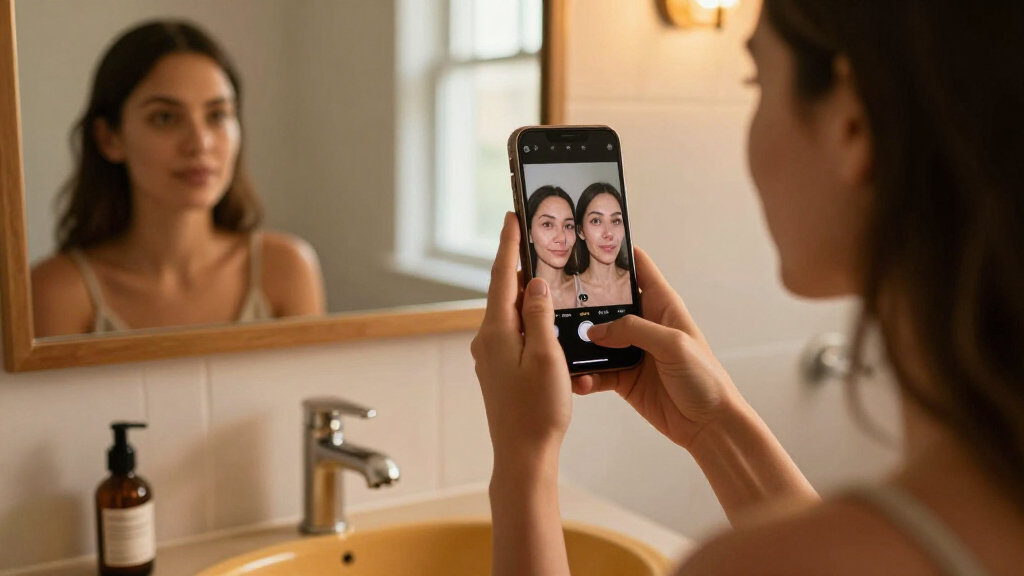
In the planned app, users would take photos through a guided weekly capture process intended to align images and normalize lighting. The app would then track selected measures—texture, evenness of skin tone and blemish counts—and let users annotate when they changed products or routines. It would report which routine changes came before measurable changes in those metrics.
The proposed validation plan calls for a 12-week cohort of 500 users. A subsample’s app measurements would be compared with dermatologist assessments of photographs, while the project would also measure retention. The proposal does not say how large that subsample would be, which dermatologists would take part, what scoring method they would use or what result would count as a successful validation.
Making Routine Changes Easier to Judge
Consistent photographs could help users review gradual changes that are hard to notice from one day to the next. If capture conditions are repeatable, a timeline may be more informative than relying on memory or comparing images taken under very different lighting. That could help a user document a change and decide what to discuss with a qualified skin-care professional.
But an app’s score would not, by itself, establish that a product caused a skin change. Skin can vary for reasons beyond a routine, and the proposal does not describe a method for separating those influences. A recorded improvement after a product change is a temporal association, not proof of cause. That distinction matters if users might spend more based on app feedback or stop using a product that appears ineffective over a short period.
The business model also gives the idea a consumer-interest angle: IdeaNavigator AI proposes combining subscriptions with affiliate revenue from products correlated with user improvement. The plan does not explain how recommendations would be selected or whether affiliate relationships would affect what users see. Clear disclosure and separation between measurement and sales recommendations would be relevant to evaluating the product if it is developed.
As an affiliate, we earn on qualifying purchases.
The Proposed Tracking Workflow
The concept is framed as a focused first use for a skin-care tracking app, rather than a broad beauty-tech platform. Its central premise is that changes in skin may take long enough to become visible that people can have trouble deciding whether a routine is working. Weekly image capture is proposed as a way to create a more regular record.
IdeaNavigator AI says controlled capture and models that assess skin metrics could now make this kind of tracking credible. That is the proposal’s rationale, not an independently established finding in the material provided. No model results, published accuracy measures, product demonstration or outside assessment are included. The planned comparison with dermatologist photo assessments is therefore a proposed test, not evidence that the measures already match professional review.
The proposal identifies beauty technology and skin-care apps as its market and suggests testing user retention alongside measurement quality. Those are two separate questions: whether the app can track selected visual features consistently, and whether people will keep using it. A retention result alone would not establish that the metrics are accurate or that the app improved skin outcomes.
As an affiliate, we earn on qualifying purchases.
Accuracy, Attribution and Privacy
The proposal reports no completed trial, so it is not yet possible to tell whether the app can reliably measure texture, tone or blemishes across different users, devices and capture conditions. Details about image processing, lighting controls and the scoring thresholds are not provided. Nor does the proposal specify how dermatologist assessments would be standardized or compared with the app’s results.
It is also unclear whether the app could distinguish a product-related change from natural variation or other changes in a user’s routine. The suggested report would identify routine changes that came before measured improvement, but the information provided does not describe a controlled study that could show those changes caused the improvement.
The plan does not address how facial images would be stored, protected, deleted or used to train models. It also gives no launch date, subscription price, affiliate terms or criteria for deciding whether the pilot succeeded. These are open questions, not confirmed shortcomings of a released product: no launch or operating service is described.
dermatologist skin assessment device
As an affiliate, we earn on qualifying purchases.
As an affiliate, we earn on qualifying purchases.
Results Needed Before Wider Claims
The next stated step is to conduct the proposed 12-week, 500-person cohort, compare app readings with dermatologist assessments for a subsample, and track whether participants continue using the app. No start date, recruitment details or publication schedule are given. Until the test is run and its methods and results are made available, claims about measurement quality or consumer benefit remain unverified.
A useful report of the test would explain who participated, how images were captured, how the dermatologist comparison was conducted and how often the app’s scores agreed with those assessments. It would also clarify whether retention was measured through the full study and how product-linked affiliate recommendations, if any, were handled. For users considering any tracking tool, the practical takeaway for now is to treat photo timelines as documentation rather than a diagnosis or proof that a product caused a change.
Source: IdeaNavigator AI
As an affiliate, we earn on qualifying purchases.
Key Questions
Is the skin-care selfie app available now?
The information describes a proposed app and validation plan. It does not provide a release date or confirm that a working product is available.
What would the app track?
The proposed system would use weekly guided photos to monitor skin texture, tone evenness and blemish counts, while allowing users to record routine changes.
Would a measured improvement prove a product worked?
No. A change that follows a product or routine change does not establish that it caused the change. The proposal does not describe a method that would separate product effects from other influences.
How would the proposed measurements be checked?
The plan calls for comparing app metrics with dermatologist photo assessments for a subsample of participants in a 12-week cohort. The subsample size and assessment method have not been specified.
How would the app make money?
IdeaNavigator AI proposes a subscription and affiliate revenue from products associated with user improvement. Pricing, recommendation rules and disclosure practices are not provided.
Source: IdeaNavigator AI
Cold & flu season Picks
humidifiers
As an affiliate, we earn on qualifying purchases.