
For most home users, I’d start with the Comfytemp Dual-Channel TENS Unit with Specialized Pads and Carrying Case, which pairs targeted pad options with independent channels and practical storage. The OMRON Max Power Relief is a standout for buyers who prefer a familiar, straightforward wired unit, while the TENKER Rechargeable TENS Unit offers multiple pads and modes for people who want more setup flexibility. The main tradeoff is between simple controls and expanded modes, and between wireless convenience and the predictable connection of electrode leads. Pad compatibility, charging needs, and how many areas you want to treat in one session can matter more than a long mode list. Read on for the full breakdown and the best match for different home routines.

Get wellness gear delivered free with Prime
- Fast, free delivery on millions of items
- Prime Video, Amazon Music and more included
- Member-only deals all year
Key Takeaways
Two channels can matter more than a large mode count. The Comfytemp Dual-Channel model is a leading choice when you want to manage two treatment areas or separate channel settings; a bigger mode list alone does not promise a better fit.
Wireless designs trade lead-free convenience for more setup variables. Several Comfytemp, AUVON, Easy@Home, and KingPavonini options emphasize wireless use, while the OMRON and TENS 7000 represent more conventional wired formats.
Pad quantity and shape affect practical flexibility. TENKER’s eight pads and AVCOO’s 12-pad package offer more pieces to arrange or rotate, but buyers should still check pad dimensions, connector type, and replacement availability.
Multi-function labels need a closer read. TENS-only, TENS/EMS, and 3-in-1 models are not interchangeable; choose the functions you will use rather than paying attention only to the largest mode count.
There is no single best format for every home. A compact wireless unit may suit a user who values fewer cables, while a wired device can be easier to adjust during a session and may be a better fit for buyers who prefer a handheld controller.





More Details on Our Top Picks
Comfytemp Dual-Channel TENS Unit with Specialized Pads and Carrying Case
The main distinction here is pad coverage: oversized pads for the neck and shoulders and lower back sit alongside six universal pads, making this a practical choice when a standard set of small electrodes feels limiting. Its independent A/B controls let you set each channel separately, while the 2.76-inch display and 20 intensity levels give you clear feedback as you adjust. Compared with the OMRON Max Power Relief, this Comfytemp offers more pad shapes and channels to work with, but the OMRON has a simpler two-mode approach and reusable washable pads. This unit’s 20 modes give more variety, though fitting electrodes still takes setup, and replacement pads are sold separately. The included carrying case helps keep the device and its accessories together between home sessions or trips.
Pros:- Oversized pads provide broader coverage for the neck, shoulders, and lower back.
- Independent channel controls allow separate intensity adjustments.
- Large display and simplified button layout support straightforward operation.
- Carrying case keeps the device and accessories organized.
Cons:- Replacement electrode pads are sold separately.
- Electrode pads must be positioned on the body for each session.
Best for: Home users who want larger electrode coverage for the neck, shoulders, or lower back, plus separate settings for two channels.
Not ideal for: People who want a cable-free device or do not want to position and replace adhesive electrode pads.
- Channels:Dual channel
- Display:2.76-inch display
- Modes:20
- Intensity levels:20
- Channel controls:Independent A/B controls
- Specialized pads:Neck and shoulder pad; lower back pad
- Additional pads:6 universal pads
- Electrode design:4-snap
- Included accessory:Carrying case
Our verdict“Choose this Comfytemp if broad pad coverage and independent channel settings matter more than wireless operation.”
Wireless TENS and EMS Muscle Stimulator with 12 Modes
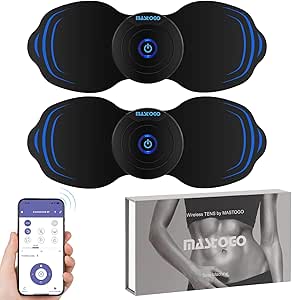
This is the app-first choice for someone who wants both TENS and EMS presets in a compact wireless setup. The DOMAS app controls six modes of each type, with 20 intensity levels and session timing from one to 60 minutes, so settings can be adjusted without handling a separate wired controller. Compared with the Comfytemp Wireless TENS Unit with 30 Modes, this model adds EMS presets and a session timer, but offers fewer total modes and depends on a smartphone for app-based control. That phone requirement is a real limitation if you prefer physical buttons or want to use the device without your phone nearby. USB recharging and six included pads make it ready for home use, though the adhesive pads need skin contact and cleaning to maintain them.
Pros:- Wireless snap-on design avoids electrode cables and a separate remote.
- Includes six presets each for TENS and EMS.
- App allows intensity adjustment and session timing from 1 to 60 minutes.
- USB rechargeable and supplied with six electrode pads.
Cons:- App-based control requires a compatible smartphone and the DOMAS app.
- Adhesive pads need skin contact and may require cleaning.
Best for: Smartphone users who want wireless sessions with both TENS and EMS presets and adjustable session timing.
Not ideal for: People who want physical controls, do not have a compatible iOS or Android phone, or prefer not to maintain adhesive pads.
- Stimulation modes:12 total: 6 TENS and 6 EMS
- Intensity levels:1–20
- Timer:1–60 minutes
- Control:DOMAS app via Bluetooth
- Charging:USB rechargeable; approximately 2 hours to full charge
- Included electrode pads:4 standard pads and 2 small pads
- Attachment:Wireless snap-on design
Our verdict“Pick this model if phone control and a mix of TENS and EMS presets matter more than having a larger mode selection.”
OMRON Max Power Relief TENS Unit Muscle Stimulator
The OMRON PM500 favors a simple, conventional setup over the many presets and wireless controls found on the Comfytemp models. Its massage and pain modes, adjustable intensity, clear display, and included placement guides make it a more approachable fit for someone who wants a compact home unit with fewer choices to sort through. The washable reusable pads also avoid the need to replace electrodes after every few sessions, though they are intended for one person and are rated for approximately 150 total uses. Unlike the wireless Comfytemp options, the OMRON uses electrode cords and two AAA batteries, so setup is less streamlined and the cables limit movement. Sessions run for 15 minutes, with recommended use capped at 30 minutes up to three times daily; that guidance may feel restrictive to buyers seeking longer sessions.
Pros:- Clear display and intuitive controls support straightforward use.
- Offers massage and pain modes with adjustable intensity.
- Reusable, washable pads are designed for approximately 150 total uses.
- Includes batteries, electrode cords, pads, and placement guides.
Cons:- Uses electrode cords rather than a wireless setup.
- Sessions are 15 minutes, with recommended use limited to 30 minutes up to three times daily.
- Pads are for single-patient use only.
Best for: First-time TENS users who want a recognizable, corded unit with included pads, clear instructions, and a limited set of modes.
Not ideal for: People who want wireless movement, numerous presets, or sessions longer than the stated 15-minute interval.
- Model:PM500
- Therapy type:TENS
- Modes:Massage mode and pain mode
- Session length:15 minutes
- Maximum therapy duration:30 minutes, up to 3 times a day
- Pads:2 reusable, washable pads; approximately 150 total uses
- Power:2 AAA batteries
- Included accessories:Pad holder, electrode cords, instruction manual, quick start guide, and pad placement guide
- Pad use:Single-patient use only
Our verdict“Choose the OMRON if you prefer a guided, corded TENS routine over app control and a broad menu of modes.”
Comfytemp Wireless TENS Unit with 30 Modes
With two independently adjustable wireless hosts, this Comfytemp suits home users who want to place stimulation on separate areas without routing electrode leads across the body. The app provides 30 modes and 20 intensity levels, while its two butterfly-shaped and two line-shaped pads offer different coverage options. Compared with the Wireless TENS and EMS Muscle Stimulator with 12 Modes, this model gives you more TENS mode variety and two hosts, but its control path is less flexible: it requires the Comfytemp app and includes no remote. The app does not require registration, which keeps setup simpler, yet a smartphone remains necessary for control. Its pads can be rinsed and reused for more than 60 cycles; that saves repeated pad changes, but adhesion depends on cleaning and air-drying them properly.
Pros:- Two wireless hosts can be adjusted separately or used at the same time.
- App offers 30 modes and 20 intensity levels without requiring registration.
- Wireless design avoids electrode cables during use.
- Reusable pads can be rinsed and are specified for more than 60 cycles.
Cons:- A smartphone app is required for control, and no remote is included.
- Pads need cleaning and air-drying to maintain adhesion.
Best for: People who want wireless stimulation on two areas and are comfortable managing settings through a smartphone app.
Not ideal for: Buyers who want a physical remote or controls on the device, or who do not want to clean and air-dry reusable adhesive pads.
- Type:Wireless TENS muscle stimulator
- Modes:30
- Intensity levels:20
- Hosts:2
- Electrode pads:4: 2 butterfly-shaped and 2 line-shaped
- Pad dimensions:Butterfly: 5.2 × 2.4; line: 3.5 × 2.8
- Pad reuse:More than 60 cycles
- Control:Comfytemp app; registration not required
- Charging:Rechargeable
Our verdict“Choose this model if dual-area wireless use and app-based mode choice are more important than having physical controls.”
Comfytemp Wireless TENS Unit and Muscle Stimulator with 30 Modes
This version stands apart from the app-controlled Comfytemp Wireless TENS Unit with 30 Modes by offering a remote and buttons on each unit, giving you ways to adjust settings without relying on a phone app. Its two units can operate separately or together, and the 30 modes and 20 intensity levels provide plenty of choice for different home sessions. Four reusable PET pads come in butterfly and line shapes, while the included case helps keep the kit organized. The tradeoff is that the product data does not specify battery life or charging details, leaving less clarity about upkeep than the app-controlled Comfytemp, which is listed as rechargeable. The pads also need rinsing and air-drying to restore adhesion, so this is not a zero-maintenance option.
Pros:- Remote control and buttons on each unit provide alternatives to app-based control.
- Two units can be used together or separately for different body areas.
- Offers 30 modes and 20 intensity levels.
- Includes four reusable PET pads in two shapes and a carrying case.
Cons:- Battery life and charging details are not specified in the product data.
- Pads require rinsing and air-drying to renew adhesion.
Best for: Home users who want two wireless stimulation units, varied pad shapes, and physical controls instead of app-only operation.
Not ideal for: Buyers who need clearly stated battery or charging information, or who want electrode pads that require little upkeep.
- Device type:Wireless TENS unit and muscle stimulator
- Number of units:2
- Modes:30
- Intensity levels:20
- Controls:Remote control and buttons on each unit
- Electrode pads:4 medical PET pads: 2 butterfly pads and 2 line pads
- Pad dimensions:Butterfly: 5.2 × 2.4 in; line: 3.5 × 2.8 in
- Pad reuse:60+ cycles
- Included accessory:Portable carrying case
Our verdict“Pick this Comfytemp if you want a wireless two-unit setup with physical controls and can accept limited charging information.”
TENKER Rechargeable TENS Unit with 24 Modes and 8 Electrode Pads
The TENKER is a strong fit for a home routine where long battery life and two treatment areas matter more than a wireless setup. Its dual channels can serve two areas at once, and the kit’s six small pads and two larger pads offer more placement flexibility than the four-pad TENS 7000 Digital TENS Unit. Up to 10 hours per charge also avoids the ongoing battery swaps required by that model. With 24 modes, 20 intensity levels, and a lock function, it gives users room to adjust settings while helping prevent accidental changes mid-session. The tradeoff is a wired layout, which is less convenient to wear while moving than the wireless Easy@Home Rechargeable Wireless TENS Unit. The USB adapter is also not included, so you’ll need a compatible one. Follow the listed safety restrictions and consult a clinician when appropriate.
Pros:- Dual output channels support two treatment areas at once.
- Up to 10 hours of use per charge reduces frequent recharging.
- Eight pads in two sizes offer flexible placement.
- Lock function helps prevent unintended setting changes.
Cons:- Lead wires restrict movement compared with wireless models such as Easy@Home.
- USB charging adapter is not included.
- Not for people with pacemakers, pregnant users, or people with epilepsy.
Best for: Home users who want rechargeable dual-channel treatment for two areas and a selection of pad sizes.
Not ideal for: People who want a wireless device for moving around during treatment, or anyone who needs a unit suitable for pacemaker use, pregnancy, or epilepsy.
- Modes:24
- Intensity levels:20
- Output channels:Dual
- Battery:Rechargeable lithium battery
- Battery life:Up to 10 hours per charge
- Electrode pads:6 × 2-inch square pads and 2 × 2 × 4-inch pads
- Charging:USB cable; adapter not included
- Warranty:12 months
Our verdict“Choose the TENKER if you want a rechargeable, wired unit with dual-channel coverage and a varied pad set for home sessions.”
AUVON Wireless TENS Unit and Muscle Stimulator with 24 Modes and 6 Pads
The AUVON’s main advantage over wired home units is the two wireless pods and charging case: once the pads are positioned, lead wires don’t tether you to the controller. That makes it a better match for light movement around the house than the TENKER Rechargeable TENS Unit, though its pods still need to stay attached securely. Its 24 TENS, EMS, and massage modes, 30 intensity levels, and adjustable 10–90-minute sessions offer more setting range than the six-program Easy@Home. The case adds practical staying power, with up to 20 hours when charging two pods, while a short charge can provide additional use. The tradeoff is that this design depends on adhesive pads, which are described as reusable for up to 45 uses, and replaces the straightforward wired controls of traditional units with a pod-and-case system. Check the safety notice before use.
Pros:- Two wireless pods and a charging case reduce cable clutter.
- Combines TENS, EMS, and massage modes.
- 30 intensity levels and sessions from 10 to 90 minutes allow fine adjustment.
- Type-C charging and quick-charge support add convenience.
Cons:- Pads are described as lasting up to 45 uses, so replacements may be needed.
- Wireless pods must remain securely attached to the pads during use.
- Not for people with pacemakers, pregnant users, or people with epilepsy.
Best for: People who want a cable-free home setup, multiple stimulation types, and adjustable session lengths.
Not ideal for: Buyers who prefer conventional lead wires or want to avoid replacing adhesive pads; not for people with pacemakers, pregnant users, or people with epilepsy.
- Modes:24 TENS, EMS, and massage modes
- Intensity levels:30
- Session duration:10–90 minutes; 30-minute default
- Charging case capacity:790 mAh
- Charging case runtime:Up to 40 hours with one pod or 20 hours with two pods
- Pod runtime:Up to 8 hours
- Electrode pads:6 latex-free pads: 4 small and 2 large
- Charging connection:USB Type-C
Our verdict“Pick the AUVON if freedom from lead wires and a broad range of modes matter more than the simplicity of a traditional wired unit.”
TENS 7000 Digital TENS Unit with Accessories
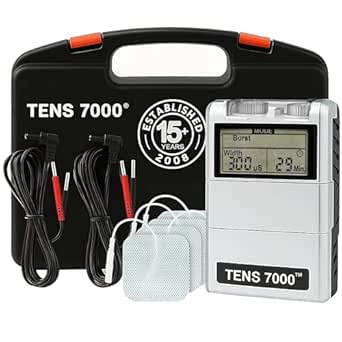
The TENS 7000 suits buyers who want a traditional wired unit with a hard carrying case and a replaceable power source. It arrives with a 9V battery, two lead wires, and four reusable pads, so the basic setup is ready without needing to charge a rechargeable battery. Compared with the TENKER, it has fewer included pads and no stated rechargeable runtime; compared with the Easy@Home, it gives up wireless operation. Its description mentions multiple therapy modes, but does not specify how many or what they are, making it harder to compare settings before buying. The included case and two lead wires are useful for keeping the kit together at home, though the listed dimensions and 13.7-ounce weight make it less compact than the slim AVCOO TENS/EMS Muscle Stimulator. This is a practical choice for buyers who favor a familiar battery-powered format over feature detail.
Pros:- Includes a 9V battery, so it can be set up without charging.
- Two lead wires support a wired treatment arrangement.
- Hard carrying case keeps the unit and accessories together.
- Includes four reusable electrode pads.
Cons:- Requires a 9V battery rather than a rechargeable power source.
- Available therapy modes are not specified in the product data.
- Includes only four pads, fewer than the TENKER and AVCOO kits.
Best for: Home users who prefer a conventional wired TENS unit with a hard case and an included replaceable battery.
Not ideal for: Buyers who want a rechargeable or wireless device, a clearly stated mode count, or a large supply of electrode pads.
- Model:TENS 7000
- Manufacturer:Roscoe Medical
- Power:One 9V battery, included
- Included accessories:Two lead wires, four reusable electrode pads, user manual, hard carrying case
- Product dimensions:8.75 × 2 × 7.75 inches
- Item weight:13.7 ounces
- Therapy modes:Multiple modes; number and details not specified
Our verdict“Choose the TENS 7000 if you value a ready-to-use, battery-powered kit and can accept limited detail about its mode options.”
AVCOO TENS/EMS Muscle Stimulator with 30 Modes and 12 Electrode Pads
The AVCOO stands out for home users who need more pad choices for different treatment areas. Its 12 latex-free snap-button pads come in three shapes and sizes, a broader assortment than the six-pad AUVON wireless kit or the four-pad TENS 7000. The unit also combines TENS and EMS, with 30 modes and 30 intensity levels, so it covers more stimulation options than the TENKER’s stated TENS-focused setup. At just 0.09 lb and 4.8 × 1.3 × 0.5 inches, it is easy to store or carry between rooms. That portability comes with a wired format, unlike AUVON’s wireless pods, and pad adhesion can weaken with repeated use even though the pads are described as reusable for more than 50 uses. It is a feature-rich small unit, but users should expect to manage lead wires and pad upkeep.
Pros:- Combines TENS and EMS functions in one device.
- Includes 12 latex-free pads in three shapes and sizes.
- Compact 0.09-pound design is easy to store or carry.
- Offers 30 modes and 30 intensity levels.
Cons:- Wired operation is less convenient for movement than the AUVON wireless kit.
- Pad adhesion may diminish after repeated use.
- The kit’s 12 pads are a finite supply, despite their stated reusability.
Best for: Home users who want TENS and EMS functions, a lightweight controller, and several pad shapes for different body areas.
Not ideal for: People who want a wireless setup or prefer not to maintain reusable adhesive pads; consult a clinician about suitability if you have a medical condition.
- Functions:TENS and EMS
- Modes:30
- Intensity levels:30
- Battery life:Up to 30 hours
- Weight:0.09 lb
- Dimensions:4.8 × 1.3 × 0.5 inches
- Electrodes included:12 snap-button, latex-free pads in three shapes and sizes
- Pad reusability:More than 50 uses
Our verdict“Choose the AVCOO if pad variety and a lightweight TENS/EMS unit matter more than wireless wearability.”
Easy@Home Rechargeable Wireless TENS Unit and EMS Muscle Stimulator
Easy@Home is the more straightforward wireless pick for buyers who want two-button controls and a short list of automated programs rather than the AUVON’s 24-mode system. It offers six programs and 20 intensity levels, with sessions adjustable up to 60 minutes; a separate 20-minute cycle with auto shutoff is also listed. Its wireless design avoids the lead wires used by the TENKER and TENS 7000, which can make a home session easier to manage under clothing. The tradeoff is less stated program variety than the AUVON and no pad count or pad sizes in the supplied product details, so buyers have less information about what comes in the kit. Safety restrictions are broader than a simple pacemaker warning: the product advises against use with certain cardiac conditions, implanted metal devices, or epilepsy. Read the safety instructions before use.
Pros:- Wireless design avoids lead wires during home use.
- Rechargeable lithium-ion battery supports repeated sessions.
- Two-button control keeps operation simple.
- Six programs and 20 intensity levels offer basic adjustment.
Cons:- Six programs provide less stated variety than the AUVON’s 24 modes.
- Pad count and sizes are not specified in the supplied product data.
- Not suitable for people with a pacemaker, certain cardiac conditions, implanted metal devices, or epilepsy.
Best for: Home users who want a rechargeable wireless TENS/EMS device with simple controls and a small set of automated programs.
Not ideal for: People who want many selectable modes or detailed pad information, and anyone with the listed cardiac conditions, implanted metal devices, or epilepsy.
- Device type:TENS and EMS muscle stimulator
- Design:Wireless
- Programs:6 automated programs
- Intensity levels:20
- Controls:Two-button control
- Power:Rechargeable lithium-ion battery
- Session duration:Manually adjustable up to 60 minutes
- Auto shutoff:20-minute cycle with auto turnoff feature
Our verdict“Choose Easy@Home if simple wireless operation matters more than a large mode selection or detailed accessory information.”
Neocarbon TENS Unit Muscle Stimulator Pro, Red
The Neocarbon is the strongest fit here for home users who want a wired unit with plenty of adjustment and less frequent charging. Its 36 modes, 20 intensity levels per channel, and 12 reusable pads give it more setup flexibility than the AUVON 24-mode TENS unit, while USB-C charging and up to 50 hours of use suit a device kept ready for regular sessions. The backlit LCD with enlarged icons may also be easier to read than a minimal display. The tradeoff is a conventional wired setup: pads and cables connect the treatment area to the device, unlike the KingPavonini U8PRO, which is wireless. Battery capacity and device dimensions are not specified, so I can’t gauge its size or charging reserve beyond the stated runtime. Choose it for configurable home use, not cord-free convenience.
Pros:- 36 modes and 20 intensity levels per channel offer broad adjustment.
- Includes 12 reusable square pads, two dual-plug snap cables, and pad holders.
- USB-C charging and stated runtime of up to 50 hours reduce charging interruptions.
- Backlit LCD with enlarged icons and an included travel case support at-home storage and portability.
Cons:- Wired cables and electrode pads add setup and placement steps compared with the wireless KingPavonini U8PRO.
- Device dimensions and battery capacity are not specified.
- The many modes may take time to sort through if you prefer a simple preset interface.
Best for: Home users who want numerous stimulation settings, plenty of reusable pads, and long stated runtime between charges.
Not ideal for: People who want a compact, wireless setup or need confirmed device dimensions and battery capacity before buying.
Our verdict“Choose the Neocarbon if you want a wired home unit with many settings, a large pad supply, and long stated runtime.”
AUVON TENS Unit Muscle Stimulator with 24 Modes and Premium Electrode Pads
This AUVON is the more straightforward pick for someone starting with a rechargeable home TENS unit: it offers 24 preset sub-modes across six massage modes, adjustable treatment timing, and two lead wires without adding EMS or relaxation functions. That simpler scope contrasts with the AUVON 3-in-1, which has 40 intensity levels and three therapy types for users who want more ways to customize. The included eight self-adhesive gel pads and pouch make a practical starter kit, and a stated recharge time of about one hour helps it return to use quickly. Its up-to-10-hour battery life is shorter than the Neocarbon’s stated 50 hours, so frequent users may charge it more often. The stated safety restrictions also rule it out for some buyers; people with other medical conditions should consult a doctor.
Pros:- 24 preset sub-modes across six massage modes provide choices without requiring users to build settings from scratch.
- Adjustable treatment timing supports setting session length.
- Eight self-adhesive gel pads and two lead wires are included.
- Rechargeable battery takes about one hour to recharge.
Cons:- Up to 10 hours of battery use is shorter than the Neocarbon’s stated runtime.
- Pads may need replacement after about 45 uses.
- Not for people with pacemakers, pregnant women, or people with epilepsy; other medical conditions call for medical advice.
Best for: First-time TENS buyers who want a rechargeable wired unit with preset options, adjustable timing, and included pads.
Not ideal for: People seeking wireless operation, extended runtime, or a device they can use despite the listed pacemaker, pregnancy, or epilepsy restrictions.
Our verdict“Pick this AUVON for a relatively simple, preset-led introduction to wired TENS at home, provided its safety restrictions fit you.”
AUVON 3-in-1 TENS, EMS, and Relaxation Muscle Stimulator
This AUVON makes the most sense for home users who want TENS, EMS, and relaxation in one wired device rather than a TENS-focused starter model. Its 40 intensity levels, 24 preset modes, and dual channels offer more fine adjustment than the simpler AUVON 24-mode unit, while the included small and large pads give buyers options for different placement areas. Treatment time can be set up to 90 minutes, a longer ceiling than the KingPavonini U8PRO’s 15-minute timer. That range brings a learning curve: buyers who only want a basic preset and short session may not need the extra functions. It also remains a wired design, and the pads are described as lasting up to 45 uses. The 24-month warranty is a useful ownership detail, but it does not remove the ongoing pad replacement tradeoff.
Pros:- Combines TENS, EMS, and relaxation functions in one device.
- 40 intensity levels and 24 preset modes give more adjustment than the basic AUVON model.
- Dual channels support use with two or four pads, with both square and larger rectangular pads included.
- Treatment time can be set up to 90 minutes, and the warranty is 24 months.
Cons:- Wired leads limit freedom of movement compared with the wireless KingPavonini U8PRO.
- Pads are stated to last up to 45 uses, so replacement is part of ongoing use.
- The number of functions and settings may be unnecessary for buyers who want simple operation.
Best for: Home users who want to switch among TENS, EMS, and relaxation modes and value multiple pad sizes and adjustable intensity.
Not ideal for: Buyers who want a wireless device, a minimal set of controls, or longer-lasting pads without regular replacement.
Our verdict“Choose this AUVON if you want three therapy functions, broad intensity adjustment, and a longer session limit in a wired home unit.”
AVCOO 3-in-1 TENS EMS Muscle Stimulator with 30 Modes
The AVCOO stands out for buyers who want several pad shapes and three therapy types in a portable wired kit. Its 12 latex-free pads in three shapes give more placement options than the AUVON 3-in-1’s mix of square and rectangular pads, while 30 modes and 40 intensity levels provide plenty of settings for home use. The body-part selection interface may help narrow choices without scrolling through every mode, and the stated runtime of up to 40 hours is substantial for a rechargeable unit. Compared with the Neocarbon, however, its stated runtime is shorter, and its dimensions and weight are not provided. The pad adhesive is designed for over 50 uses, but these remain consumable electrodes rather than a permanent part of the device. This is a flexible kit, not a cord-free one.
Pros:- Combines TENS, EMS, and Relax therapies with 30 modes and 40 intensity levels.
- Includes 12 latex-free pads in three shapes and sizes.
- Dual channels support targeted use, and the battery is rated for up to 40 hours.
- USB charging can use a wall charger, power bank, or laptop USB port.
Cons:- Dimensions and weight are not specified, making portability harder to judge.
- Wired leads require managing cables during use, unlike the KingPavonini U8PRO.
- Pads need replacement after repeated use despite the stated durability of over 50 uses.
Best for: Home users who want TENS, EMS, and relaxation options plus varied latex-free pads for different placement areas.
Not ideal for: People who need a wireless unit or want confirmed dimensions and weight before choosing a portable device.
Our verdict“Pick the AVCOO if pad shape variety and three therapy types matter more to you than wireless use or confirmed device size.”
KingPavonini U8PRO Wireless TENS Unit Muscle Stimulator
The U8PRO is the clearest choice here when avoiding lead wires matters more than having a large menu of settings. Its wireless dual-channel design and charging case make it easier to store and move around during a home session than the wired AVCOO or either AUVON model. It combines TENS, EMS, and massage functions, but its six preset modes and 16 intensity levels are fewer than the Neocarbon’s 36 modes and 20 levels per channel. The included four washable hydrogel pads are larger rectangular pads, which may suit broad placement but offer less shape variety than AVCOO’s 12-pad kit. A 15-minute timer also caps session length, well below the AUVON 3-in-1’s 90-minute maximum. Choose this for cord-free convenience, not extensive customization or longer uninterrupted sessions.
Pros:- Wireless design avoids lead wires during use.
- Dual channels support stimulation of multiple areas at once.
- Charging case stores and recharges the units and uses USB-C charging.
- Four reusable, washable hydrogel pads are included.
Cons:- The 15-minute timer limits uninterrupted session length compared with the AUVON 3-in-1.
- Six preset modes and 16 intensity levels offer fewer choices than the Neocarbon.
- Four pads in one specified size provide less placement variety than AVCOO’s 12 pads in three shapes.
Best for: Home users who want a wireless dual-channel unit with a charging case and expect to use short sessions.
Not ideal for: People who need longer sessions, many preset choices, or several pad shapes and sizes for different placement areas.
Our verdict“Choose the U8PRO if cord-free movement and a charging case matter more than long sessions, extensive settings, or varied pad shapes.”

How We Picked
I compared these 15 portable TENS units for the realities of home use: how clearly their controls and treatment options are described, whether they offer one or two channels, how their pads and accessories support different placement needs, and whether they use rechargeable or other power arrangements. I also separated TENS-focused products from models that add EMS or relaxation functions, since extra modes are useful only when they match the buyer’s intended routine. Portability meant more than size: storage, cables or wireless design, and the practical steps needed to prepare a session all counted.
The ranking favors a balance of usable controls, treatment flexibility, and manageable setup over headline mode counts. The Comfytemp dual-channel unit leads for its combination of channels, specialized pads, and a carrying case; OMRON and TENS 7000 stand out for buyers seeking a more traditional wired approach. Wireless and multi-function models rank higher for shoppers who value those features, but their extra flexibility does not make them the automatic choice for everyone. Product details can vary by package, so I’d verify the included pads, charging method, and replacement supplies before buying.
Factors to Consider When Choosing Portable TENS Units For Home
Choosing a home TENS unit is less about finding the longest feature list and more about matching the device to your setup, comfort, and routine. I’d work through these factors before deciding between wired, wireless, and multi-function designs.
Choose wired or wireless based on how you’ll position the controller
Wireless units reduce dangling leads and can feel less cluttered when you want to move around the house, but they still require thoughtful placement and may involve positioning separate modules on the pads. A wired controller gives you a physical control you can keep nearby, which some people find easier to adjust without reaching for a pad-mounted unit. Don’t assume wireless means hands-free or that wired means difficult: the way you sit or lie during a session matters. Think about whether you’ll use the device on a couch, at a desk, or while staying mostly still. If you want to change settings often, prioritize accessible controls over a cable-free design. If storage is the main concern, check what case or pouch is included rather than judging portability by the device alone.
Match channels to treatment areas, not to a bigger feature count
A single-channel unit may be enough if you plan to place one electrode pair on one area at a time. Dual-channel designs can support more flexible placement or separate settings across two channels, but they also ask you to manage more leads or pads. Before buying, picture the areas you expect to treat in the same session and check the device instructions for supported electrode arrangements. A common mistake is treating channel count as a direct measure of strength or effectiveness; it describes control and setup options, not a guaranteed result. If your routine is simple, a straightforward one-channel model may be easier to use consistently. If you want simultaneous setups, confirm whether intensity can be adjusted independently on each channel.
Check pad size, connector style, and replacement access
The number of included pads is only part of the story: shape and size affect where they can be placed, while connector compatibility determines which replacements you can use later. A larger bundle can be useful if you want several placement options or spare pads, yet it may add little value if the shapes do not suit your intended areas. Look for clear information on whether pads are reusable, how they connect, and where compatible replacements can be found. Avoid assuming that pads from one brand will fit another unit, even when they look similar. Keep storage and care in mind too, since dust, skin oils, and poor handling can shorten the useful life of adhesive pads. When package details are unclear, verify them before purchase rather than relying on a mode count or product name.
Choose functions you understand and expect to use
TENS, EMS, and relaxation programs describe different device functions, so a 3-in-1 label is not automatically a better choice than a TENS-focused model. Extra programs can appeal to buyers who want one device for several routines, but they can also complicate controls and make it harder to find a familiar setting. Read the manual or feature list to learn what the programs are intended to do and how settings are selected. Don’t treat a high mode count as proof that every program will feel meaningfully different. If you are new to electrical stimulation, simple controls and clear instructions may be more helpful than a broad menu. Follow the device directions and ask a clinician whether a function is appropriate for your situation.
Treat power and session setup as part of portability
Rechargeable models can reduce the need to keep spare batteries on hand, but you’ll need a charging routine and a way to notice when the unit is running low. Other power arrangements may suit buyers who prefer replaceable batteries or do not want another device to charge. Compare what is included in the package with what you will need for ongoing use, including charging cables, batteries, and replacement pads. A compact unit is less convenient if its accessories are easy to misplace or its controls are hard to read. For a device that stays at home, a carrying case can still help keep leads, pads, and the controller together. Think through the entire path from storage to setup, not just the device’s size.
Use safety guidance to narrow the field before comparing extras
Before choosing a device, read its safety instructions and check whether any listed restrictions apply to you. Electrical stimulation may not be appropriate for everyone or every body area, and instructions can differ between products and functions. Ask a qualified clinician or the device manufacturer for guidance if you have an implanted electronic device, are pregnant, or are unsure about a health condition or placement restriction. Avoid placing electrodes where the manual says not to, and do not use a device in a way that conflicts with its directions. Treat a TENS unit as a device for symptom management rather than a substitute for evaluation of new, severe, or persistent pain. Clear safety information should weigh more heavily than a long feature list.
Frequently Asked Questions
Should I choose a wireless model or a wired TENS unit for home use?
Choose wireless if managing leads is your main frustration and you are comfortable positioning the unit or modules near the pads. A wired controller can be easier to reach and adjust during a session, especially if you plan to stay seated or lie down. Wireless designs may require more attention to module placement and charging, while wired models involve routing and storing leads. Compare the controls and included accessories, not just the product label. If you are unsure, think about the setup you can repeat comfortably rather than the format that sounds more advanced.
Do I need a dual-channel TENS unit if I only treat one area at a time?
Not necessarily: a single-channel unit may suit a routine focused on one treatment area at a time. Dual-channel models can be useful when you want to manage two areas or have more control over separate electrode pairs, depending on the device’s instructions. They can also add setup complexity, so extra channels are not automatically an advantage. Check whether the model lets you adjust each channel independently and whether you expect to use that option. If you do not need simultaneous placement, prioritize easy controls and compatible pads instead.
Is a TENS/EMS combo unit a better buy than a TENS-only model?
A combo unit makes sense when you have a clear reason to use its additional EMS function and the instructions explain how to select it. If you only want a TENS device, extra functions can add menus without improving the fit for your routine. Compare the controls, not just the number of functions or modes. Read the manual to understand the intended use and safety guidance for each setting. When you are uncertain whether a function is appropriate for you, ask a qualified clinician before choosing based on versatility alone.
How should I compare electrode-pad bundles?
Start with pad shape, dimensions, connector type, and replacement availability; the largest bundle is not always the most useful. More pads can provide spare pieces or additional placement options, but only if they suit your intended use and connect to the unit. Check whether the listing identifies the pads as reusable and how they should be stored and cared for. Also confirm that compatible replacements are available, since the included set will not last indefinitely. I’d favor a clear replacement path over a high pad count with uncertain compatibility.
What should I check before using a portable TENS unit at home?
Read the product manual for placement instructions, restrictions, and any warnings that apply to your health or the areas you plan to treat. Ask a qualified clinician for guidance if you have an implanted electronic device, are pregnant, or have questions about whether electrical stimulation is appropriate for you. Do not place pads in locations prohibited by the manual, and stop if use causes an unexpected reaction. A TENS unit should not delay care for new, severe, or persistent symptoms. If instructions are unclear, contact the manufacturer or a clinician before starting.
Conclusion
For the strongest all-around home setup, I’d choose the Comfytemp Dual-Channel TENS Unit with Specialized Pads and Carrying Case; its channels, pad options, and storage make it the clearest best-overall fit in this group. The TENS 7000 is my value-minded pick for buyers who prefer a traditional wired format and accessories, while the OMRON Max Power Relief suits beginners who want a more straightforward wired option. For a more feature-rich setup, compare the AUVON 3-in-1 and AVCOO 3-in-1, but choose them only if you expect to use more than TENS. If cutting down on leads is your priority, focus on the wireless Comfytemp, AUVON, Easy@Home, or KingPavonini options and check their charging and pad details first. The right pick is the one whose controls, pad setup, and safety guidance fit a routine you can follow comfortably.